04 Mar 2016
by PhoenixKaio
in Architecture, Art, History, Norway, Symbolism, Travel, Urban Design
Tags: Akershus Fortress, Oslo, Oslo Opera House, Power, Tigersbaden
In 1870, Bjørnstjerne Bjørnson wrote a poem titled , “Sidste Sang”. In it, he illustrates a dramatic fight between a horse and a tiger. The tiger, metaphorically represented the dangerous city, while the horse symbolized the security of the countryside. This is where he first referred to Oslo as Tigerstaden, which represented his perception of the city as a cold and dangerous place.
 This has not been the case for Tom and I. We have found this snowy, northern city to be warm and friendly. Our barista from earlier this morning graciously gave us a list of restaurants to eat at, and even attempted to teach me the word for “thanks” in Norwegian, “Taak”. (I hope I haven’t been butchering the word too much, but I always like to learn how to say “please” and “thank you” when I travel. I’ve found it is a simple way to show your enthusiasm for the local history and, even though they may laugh, the locals often appreciate your effort.)
 Making use of one of the barista’s recommendations, we ventured towards Aker Brygge, a unique, waterfront development that was completed in 2014. It was formerly the site of a shipyard and industrial buildings. Vingen, a restaurant attached to the Astrup Fearnley Museet was difficult to find, but incredibly tasty! Tom had the Eggs Benedict, while I had their version of a Katz Pastrami Sandwich.
 After a brief break, we ventured back into the cold to explore the history of the Akershus Fortress. Construction of the fortress is believed to have started around 1290 when King Hakon V realized that the city needed a stronger defense center than that which currently existed. Since it lied adjacent to the sea, it allowed Norway to prosper commercially while providing the nation with a strong military presence.
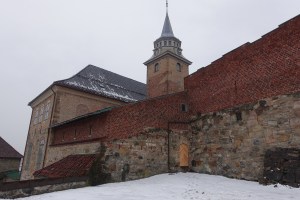 The Akershus Fortress has never been successfully besieged by a foreign enemy. However, in 1940, it surrendered to Nazi Germany without combat. The Norwegian government evacuated the capital when it was unprovokedly assaulted.

Our feet getting wary, we decided to make our last stop for the day before heading back to the hostel to rest our laurels. The Oslo Opera House is uniquely designed such that the roof of the structure angles to the ground level. This creates an elevated plaza that allows pedestrian interaction with the building. Tom and I climbed all the way up and were greeted with a panoramic view of the waterfront.
As a structural engineer,the fact that this roof is merely supported by thin angled columns is intriguing. How, exactly did they analyze the load paths/patterns through the asymmetrical characteristics of the column geometry? The minimalistic framing and specialty glass allows for optimal views of the surrounding water.
 From the roof, and at ground level, we observed the sculpture, “She Lies.” The stainless steel and glass fabrication resembles ice and depicts a symbol of power for the region. As it lays on a transient concrete platform, it is free to turn with the bidding of the tide and the wind. I think the sculpture is a metaphor. For as quick as the tides change and the wind changes direction, so too can the power shift.
P.S. Tom is currently passed out next to me. If anything, my boyfriend could certainly hibernate through a long winter if instinct required it of him. 😛
31 Dec 2014
by PhoenixKaio
in Britain, History, India, Portugal, Travel
Tags: Britain, Economy, Evolution, GDP, Goa, Mopeds, Nightlife, Rock Art, South India
 I had a generally unproductive day today. Nick went off to visit some family that he had in Mumbai and although I had time to go explore before meeting him at the airport, I decided to let myself have a lazy morning.
My original intent was to catch up on some blog posts but I found myself mesmerized by a new book I was reading on my kindle.
I caught a taxi to the airport after I checked out after noon. There, I waited for Nick to arrive after a lunchtime meeting with his uncle. When he hadn’t arrived by 1:30 pm, I had a brief panic moment that we had missed each other. This was compounded by my schizophrenic cell phone issues. Fortunately, he was just running late, and I didn’t have to deal with all his luggage on top of my own.
 We arrived in Goa around 6 pm, however, it took us about 2 hrs to taxi to our hotel because of how large the state is and the New Year’s Eve traffic. After we settled in, we rented a moped and went in search of dinner, I was surprised by how many Russians were on holiday there!
Goa has a history dating back as far as 20,000 to 30,0000 years. There are still rock art carvings that demonstrate the earliest traces of human life when our ancestors first began to transition from four legs to two legs.

Modern day Goa however can be traced back to the year 1510. It is at this point in history that that the Portuguese defeated the reigning sultan and claimed the region as a settlement. Portuguese sovereignty in present-day India would last for four and a half centuries until 1987, when, in the advent of claiming their independence from the British in 1947, the Indian Army moved to reclaim the territory that was rightfully theirs.
Goa is now one of the richest states of India, with the highest GDP per capita (2.5x the entire country’s), and an average growth rate of 8.2%! It is famous for its beaches and nightlife, which is exactly why Nick and I chose to spend our New Years Eve here.
30 Dec 2014
by PhoenixKaio
in Architecture, Art, Britain, Faith, History, India, Landscape, Myths & Legends, Portugal, Religion, Symbolism, Travel
Tags: Abstract, Aniconism, British Rule, Buddhism, Carvings, Caves, Earthquakes, Elephanta Caves, Elephants, Ganesh, God, Hindu Cosmology, Hinduism, Indian Independence, Shiva, Wisdom, World Elephants
 Elephants are creatures that are revered in India. According to Hindu Cosmology, the earth is supported and guarded by mythical World Elephants at the compass points of the cardinal directions. Sanskrit literature even attributes earthquakes to the shaking of their bodies when the elephants tire of their burden.
The deity Ganesh(a) is the god of wisdom, and he is distinctively represented by a human form with the head of an elephant, which was placed after the human head was either decapitated or burned from the body.
 However, this is not how the Elephanta Caves, with origins dating between the 5th and 8th centuries, received their namesake. In the 16th century, the Portuguese named the island “Elephanta Island” in honor of a huge, monolithically rock-cut black stone of an elephant on a mound; this unfortunately has been relocated to the Mumbai Zoo.

Credit: Nikhil Kulkarni
Despite being just 7 miles east of the port, the ferry ride took an hour to get there! Fortunately, I caught some great views of the Gateway of India, the exit causeway through which the last British troops passed through on February 28, 1948, signalling an end to British rule and the beginning of Indian independence.
In each of the caves, Shiva or Mahadeva, “Great God” is aniconically represented by a Lingam, a single rock rounded at the top. Aniconism is the avoidance of using images to represent divine beings, prophets, and religious figures.
However, I happen to find the monolithic rock to be an appropriate manifestation of Shiva.
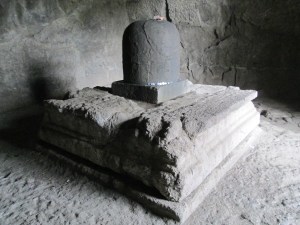
At his highest level, Shiva is considered limitless and transcendent, unchanging and formless. Why not abstractly represent him as something from nature that also adheres to these characteristics? Are rocks not powerful? Do they not withstand the test of the time?
I may not be Hindu, but even I was moved. I couldn’t help but place my palm against the rock and close my eyes, taking some time to summon my faith, and chant the Buddhist Mantra I learned as a child beneath my father’s wing.
28 Dec 2014
by PhoenixKaio
in Architecture, Art, Faith, History, India, Innovation, Natural Beauty, Travel
Tags: Astronomical, Cardinal Directions, Chaumukha, Cold, Inticate, IST, Jainism, Marble, Monsoon Palace, Mumbai, Petite, Ranakpur, Regret, Snares, Udaipur, UNESCO

Our initial plan today was to hire a taxi to day trip to Ranakpur before being dropped back at the airport for our flight to Mumbai later tonight. Unfortunately, our lack of internet connection at the hostel proved to be our downfall.
While I had posited asking the staff for advice on taking buses, Nick didn’t hear me, and I was too snuggled into my cozy cocoon to emerge from the warmth. We did not make it to Ranakpur and I regret not summoning the willpower to face the cold. Admittedly though, it was really nice to have an open day with nothing planned.

Credit: Ingo Mehling
Ranakpur is 91 km away from Udaipur, making it approximately a 1-hour car ride in US terms and a 2.5 to 3-hour travel time according to IST (one needs to factor in traffic, rough roads, and slower speed limits). It is home to a UNESCO World Heritage Site, a massive, sprawling, Jain Temple constructed entirely of marble in 1437.
 It is with sorrow that I cannot speakbout how amazing the structure was, as it has over 1444 pillars that are each uniquely carved in exquisite detail. Additionally, there is a massive rock that is carved into 108 snake heads and tails. The layout of the building is in the form of a chaumukha – four faces in each of the four cardinal directions that symbolize the cosmos.
Instead, Nick went off to meet his Uncle and I found a little cafe to savor coffee in while using their wifi for some net-based tasks. We met up again later that morning to visit Monsoon Palace.

Credit: Nikhil Kulkarmi
The Monsoon Palace was built in 1884 entirely of white marble on the Bansdara Peak of the Aravalli Hill. At a total elevation of 3100 ft overlooking Lake Pichola, the original intent was for it to be a 9-story astronomical centre to track the movement of the monsoon clouds. It would also be a vacation home for the royal family.
 Unfortunately, despite the innovative water harvesting system the building utilized in its underground cistern, the storage capacity proved to be inadequate resulting in the abandonment of the palace.
After the palace, all we had to do was get Nick a shave for the wedding, and find him some shoes. This was surprisingly almost as difficult as finding me a Saree; there’s not much you can do about a gigantor’s foot size when you are on a continent that tends to produce petite-sized humans.
27 Dec 2014
by PhoenixKaio
in Art, Dance, Family, Handicraft, History, India, Travel
Tags: Camels, Dilli Haat, Folk Dancing, Heritage, Kamar, Manjeeras, Precision, Rhythm, Shilpgram, Technique, Teratali, Tribes, Udaipur
Since Udaipur is a smaller city and Nick and I have already seen our fair share of ancient temples, palaces, and fortresses, we chose to experience the diversity of India by visiting Shilpgram.
Much like the Dilli Haat in New Delhi, Shilpgram is a heritage village composed of 5 west-zone states. Its purpose is to expose the diversity of tribal cultures to the general public and foster a spirit of collaboration between rural and urban artists. This cultural complex was incredibly large with a total square area of 70 acres!
Nick and I didn’t intend to stay for so long, but there was so much vibrancy to be seen amongst the artists. I’ve attached a brief collage below to illustrate the range of work.
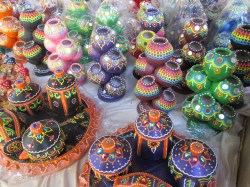


Credit: Nikhil Kulkarni and Myself (some are his and some are mine).

Credit: Nikhil Kulkarni
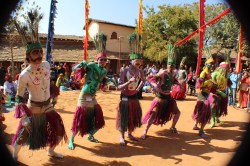
One of the things I enjoyed the most were all of the regional dances that were performed. As someone who studied traditional chinese dance for over 8 years in my youth, folk dancing continues to fascinate me. It is such a rich part of one’s ingrained heritage and it would be a true pity if these arts got lost in the sands of time.

Credit: Nikhil Kulkarni

Credit: Nikhil Kulkarni
Some of the female dancers kept inviting me to join them! I didn’t, but I did pick up the rhythm and pattern of their movements. At the end of it all, they were really friendly and invited me to take a picture with them.

Credit: Nikhil Kulkarni
Nick and I both hopped on Camels and went for a ride as well.
We finished our day with a sunset boat ride on the lake, followed by more famous dances from Rajasthan at the Bagore Ki Haveli.

Credit: Nikhil Kulkarni

Credit: Nikhil Kulkarni
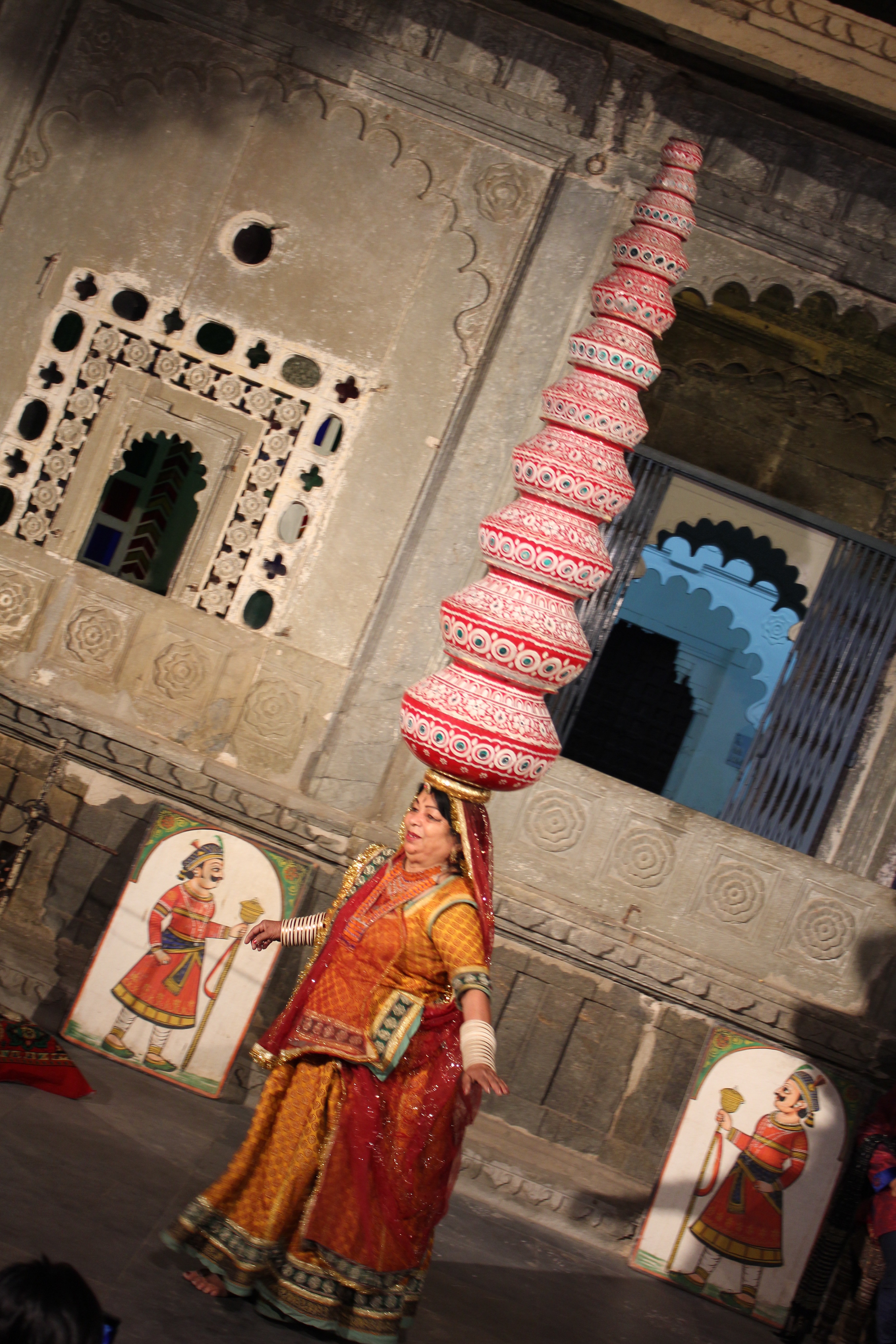
My favorite dance by far was the Teratali dance. Performed by the Kamar tribe while sitting down, the woman balance a pot on their heads and clench a sword between their teeth while they use Manjeeras (cymbals) to acoustically provide thirteen different beats. The sounds made vary by the angles at which the cymbals collide, making this dance one that requires technique and precision.
Unfortunately, the seating area was less than optimal, otherwise I would have provided a video. 😦
26 Dec 2014
by PhoenixKaio
in Architecture, Art, History, India, Myths & Legends, Politics, Travel
Tags: Architectural Blends, City Palace, Desert, First World Problems, Fort, Hermit, Lakes, Maharana, Sleeper, Toilets, Udaipur, Venice
 Nick and I actually delayed our travels to the city of Udaipur by a day because we wanted to visit the Fort. Hence, rather than a 7:30 AM bus, we caught a 6.5-hr sleeper bus. Since it was a non-AC bus, we were feeling pretty optimistic that it would not be too cold. After all, how often does a typical commercial bus have openly ventilated windows? Much to our dismay, even though each cot had its own glass-enclosed cubicle, the windows to open air were not tightly sealed, and therefore it was impossible to limit the amount of penetrating cold desert air.
 Even worse, I woke up at 3 AM with a pressing need to use the toilet, with no possibilities in sight. I was concerned that even if I asked the driver to pull to the side, the language barrier would prevent him from fully understanding that I needed him to wait for me. I was terrified that he’d drive off and leave me, in the desert, by myself, in the middle of the night. A long struggle later, Nick finally woke up, and he made sure the bus driver didn’t leave me behind (though he was concerned when he felt the wheels of the bus inching). 😦 There is never anything glamorous about popping a squat in a dark ally out of sheer necessity.

Credit: Nikhil Kulkarni
When we finally arrived at our hostel around 6 AM, they had given our beds away (even though we had called the previous day to give them fair warning)! Nick and I ended up having to squeeze ourselves into two very small chairs with a blanket to catch a little more shut-eye.
Needless to say, we did not feel very rested when we finally awoke, and had a pretty lazy day.

Credit: Nikhil Kulkarni
Udaipur, often called the “Venice of the East” for the its beautiful lakes, was founded in 1559 by Maharana Udai Singh II as the last capital of the Mewar Kingdom. It was during this time that the City Palace first came into existence. In reality, the City Palace is not merely one palace, rather it is a sprawling complex consisting of many different palaces that were constructed by 76 different kings over the course of nearly 400 years.

Credit: Nikhil Kulkarni
The royal family, the Sisodia Rajputs “Worshipers of the Sun God,” built each palace to face east, in order to greet the rising sun. The exquisite facade of the 11 palaces spans a total length of 800 ft, and a total height of 100 ft. A unique trait of the architecture is that, since the total structure was built over an extended period of time, one can see a diverse blend of different styles. Each characteristic of the Rajasthani, Mughal, Medieval, European, and even Chinese Architecture is paradoxically homogenous and unique at the same time.
It is said that the Maharana (distinct from the term Maharaja) built his palace atop the hill following the advice of a hermit who he had found meditating at the summit.
25 Dec 2014
Merry Christmas from Jodhpur!
 We all woke up late this morning due to the festivities of last night. The staff had cleaned up the cake (from the glitter firecrackers) and shared some slices with us. Nick didn’t pull his string aggressively enough, so he decided to pour all of his glitter over my head. -_- I may still be sparkling….
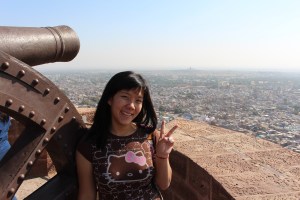
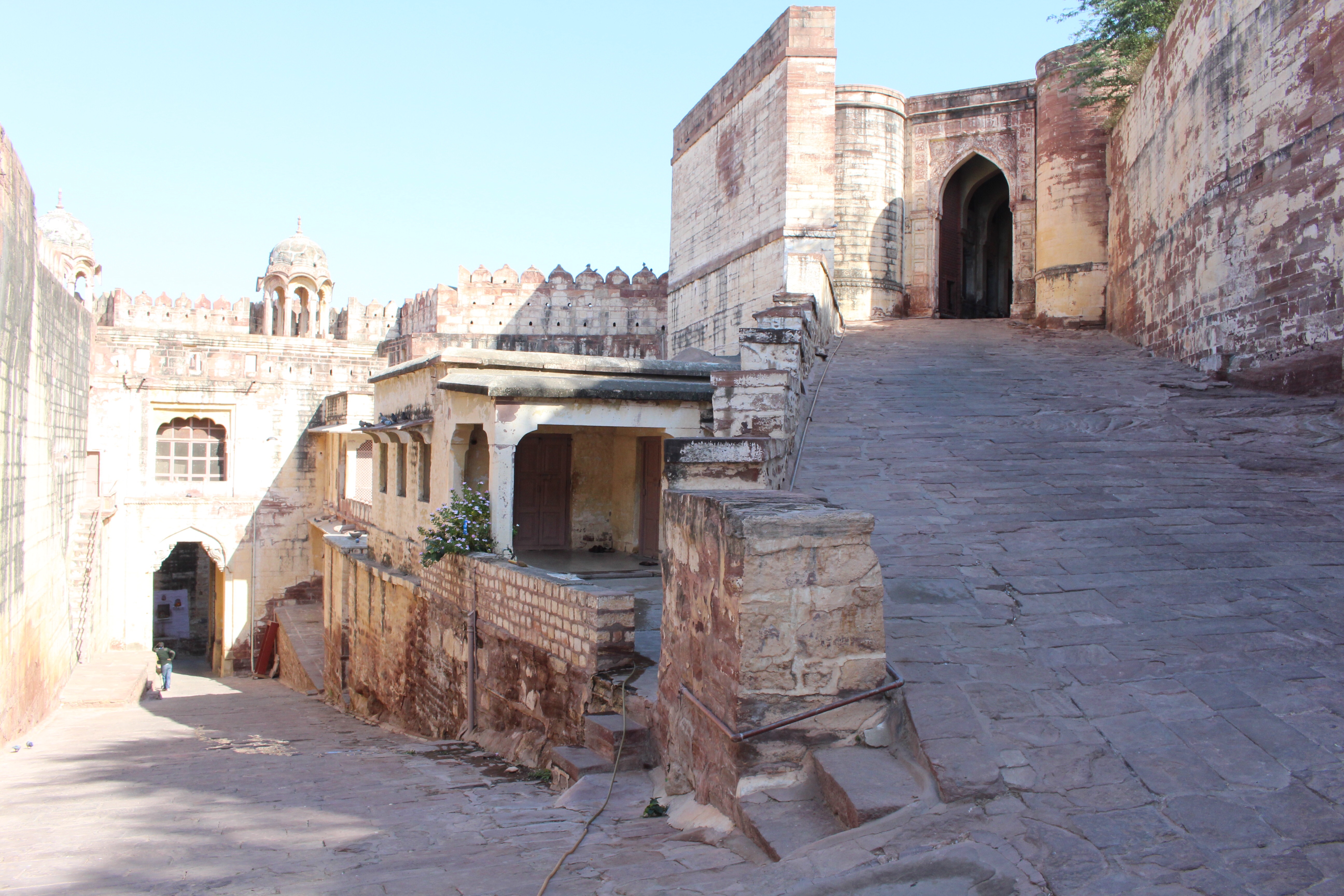
Craig, one of the new friends we made last night, was traveling alone so we invited him to explore the city with us. We trekked up the hill at the center of the Jodhpur old city and entered one of the seven gates of Mehrangarh Fort.

The fort is situated 400 ft above the city and surrounded by thick walls. Within the complex are several palaces known for the intricacy of their carvings and the botanical diversity of their courtyards.

Legend says that Bhaurcheeria, “The Mountain of Birds,” initially had a single human occupant. In order to build Jodha’s fort, Cheeria Nathji, “Lord of the Birds,” was forced to leave. In his anger, the hermit cursed Jodha:
“Jodha! May your citadel ever suffer a scarcity of water!”
Credit: Nikhil Kulkarni
Nathji was only marginally appeased by the construction of a house and temple within the fort that was in close proximity to the cave that the hermit had meditated in. However, even to this day,the area is plagued by a drought every 3 to 4 years.

As an even more extreme measure to ensure his new site was propitious, Jodha buried a man named “Raja Ram Meghwal” alive beneath the foundation. In return, Meghwal’s family was guaranteed to be looked after by the Rathores. Even to this day, his descendants still live in Raj Bagh, an estate beaquethed to them by Jodha.
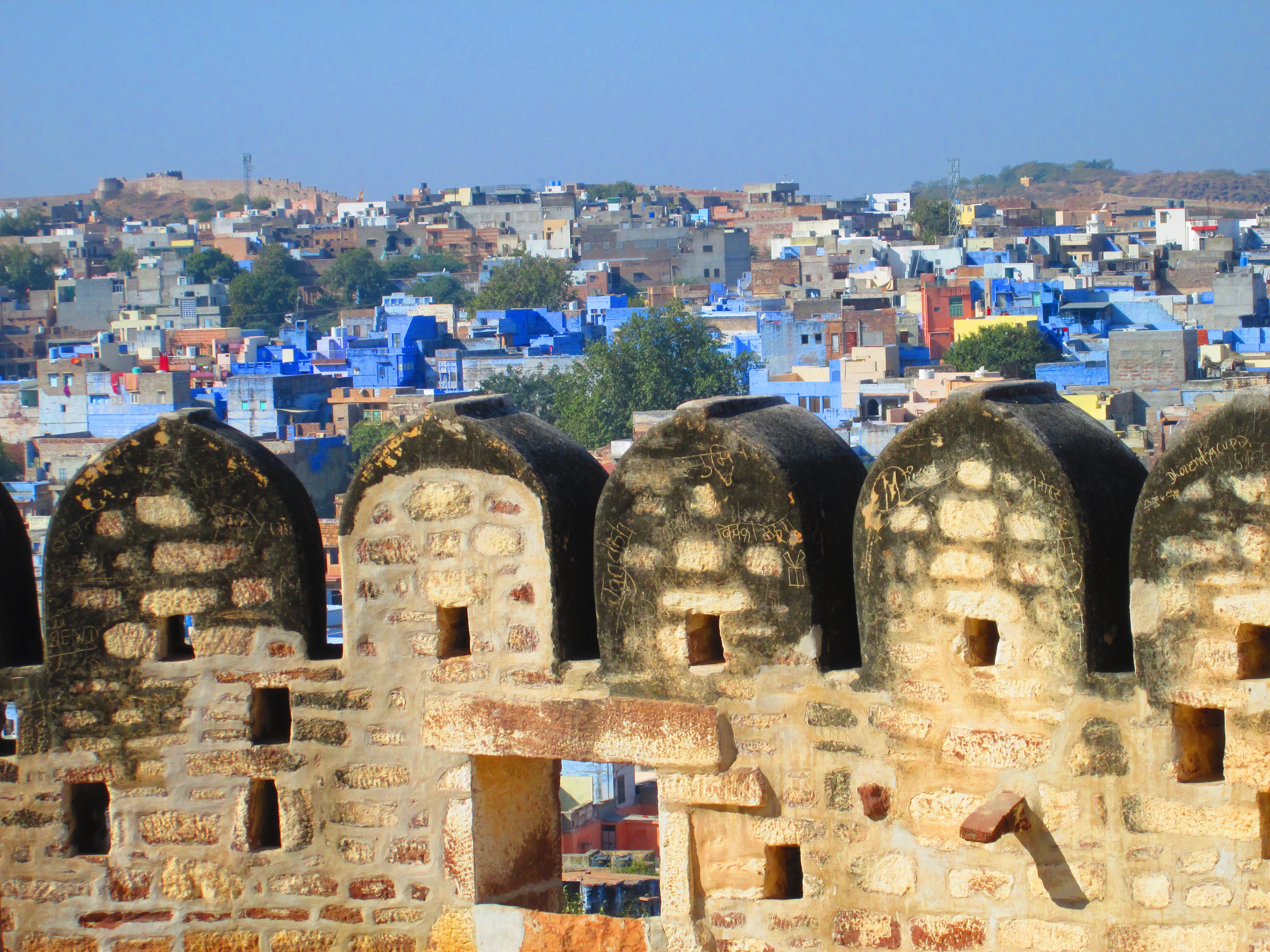
 After catching a gorgeous view of the “Blue City” from high above, we started our descent on the other side of the hill, and came across some traditionally dressed girls with baskets on their heads. I find it quite fascinating that even in this modern-day and age, a diverse array of traditional clothing can be seen in India as a stark contrast to the more readily adopted Western Clothing.
 We then paused by the Jaswant Thada for a breather, before continuing to engage in some aimless traipsing through the streets.
Link
by PhoenixKaio
21 Dec 2014
by PhoenixKaio
in Architecture, Faith, History, India, Innovation, Landscape, Myths & Legends, Natural Beauty, Religion, Symbolism, Travel
Tags: Camels, Conservative, Dress Up, Elephants, Galta Ji, Jaipur, Jal Mahal, Man Sagar Lake, Monkeys, Mughal, Pilgrimage, Rajput, Red Sandstone, Strange Couples, Temple
This morning, we both enjoyed the luxury of sleeping in before heading for a walk around the Man Sagar Lake to observe the beauty of the Jal Mahal “Water Palace.” We even got to see an elephant just strolling down the street amidst the motorcycles and rigshaws, and a camel just resting its legs!


Interestingly, Maharaja Madho Singh I constructed the complex in 1750 intending for it to be a lodge for himself and his entourage during duck hunting parties, it was never intended to be a palace.
 It is considered a classic example of Rajput and Mughal Architecture, and as we’ve seen often during our trip, composed entirely of red sandstone. There is a rectangular chhartri on the roof, and four octagonal chhattris on each of corners of the building. They are elevated dome-shaped pavilions that have become a signature of Indian Design.
Based on plain observation, one cannot derive the complexity of design and technological forethought involved in this structure. While we only see it as a one-story building, in reality, the palace has five floors in total, four of which are submerged in the lake

As we savored the nice weather and strolled along the lake, we came across a costume peddler and decided to have fun and play “dress-up.” The most awkward part of this, was when they wanted us to pose and take a picture as a couple. [Insert Awkward Turtle].

Credit: Nikhil Kulkarni
India is still a conservative nation, so when they see a man and a woman travel together, assumptions are often made. Additionally, seeing an Indian and an Asian together is almost an unheard of circumstance. Fortunately, Nick and I had a good laugh about this.

We wandered the area and found ourselves a nice open garden to take a seat in and relax, before grabbing lunch and heading to hike up to Galta Ji.
 The pilgrimage site lies in the town of Khania-Balaji, just outside of Jaipur. It is known for its natural water springs that accumulate in tanks “kunds”. Thousands come to bathe in these waters every year as it is considered auspicious. Additionally, some believe that the Saint Galav lived here. He meditated, did penance, and survived for years just drinking cow’s milk.

Credit: Nikhil Kulkarni
Galta Ji is also commonly called “The Monkey Temple” as a tribe of monkey lives there. Nick was being mean and joking that he had reunited me with my family. T.T.
I’ve self-perpetuated this ongoing joke when, a few years ago, I discovered that my strangely shaped thumbs coincidentally align with the thumb shape of a gorilla. It is all in good fun though, and I enjoyed getting up close and personal with my brethren.


Credit: Nikhil Kulkarni
20 Dec 2014
by PhoenixKaio
in Architecture, Art, History, India, Innovation, Natural Beauty, Travel, Urban Design
Tags: Air Flow, Ingenuity, Intricacies, Jai Sing II, Jaipur, Lattice Work, Rajasthan, Royalty, Urban Planning, Vastu Shastra, Ventilation
To recap thus far, we have visited the states of Delhi – the capital territory of India – and Madhya Pradesh – “the heart of India” – and are now exploring Jaipur, the capital city of Rajasthan.
 Jaipur was founded by Jai Sing II, the Raja of Amer in 1727. His capitol originally lay 51 km away, but water was becoming scarce, and Jai felt that shifting his city would increase the population. After much deliberation and the architectural guidance of Vidyadhar Bhattacharya, the city was laid-out in accordance with the classic principles of Vastu Shastra. Its core concept centers around urban planning for the comfort of its citizens and the integration of the built environment with nature, while trying to maintain perfect geometric patterns (Yantra), symmetry, and directional alignment.

Credit: Nikhil Kulkarni
The first stop of our day was the Hawa Mahal, “Palace of Winds.” Built in 1799 by the Maharaja Sawai Pratap Singh, the structure was designed by Lal Chand Ustad to form the crown of Krishna. The five-story exterior face is reminiscent of the honeycombs of a beehive, and has 953 jharokhas (small windows) with intricate latticework. Not only did the windows allow royal ladies to observe daily life without being seen, but it also resulted in the Venturi Effect, natural ventilation that helped promote the flow of cool air through the building in the summers.
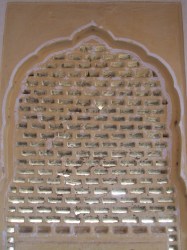 I also noticed that a lot of the window slots slanted downwards. Jaipur, named “The Pink City” because so many of its buildings are painted pink, lies in the desert. The slant of the window perforations allowed residents access to fresh air, without putting them at the mercy of the blazing sun. I found this to be a particularly ingenious idea for being created almost 300 years ago.
We had then hoped to visit the City Palace, but were rebuffed by how expensive it would have been to tour the interior (about 2500 rupees for foreigners with no cameras allowed).
 While the pictures shown at the ticket office were pretty jaw dropping, this price point would have been equivalent to $45! It would have been the most expensive tourist destination I’d ever gone to across every continent and country. At the same time, this is marginally understandable as Rajasthan is one of the few states with present-day Royalty. They only chose to merge with the Indian Union after Indian Independence in 1949.

Credit: Nikhil Kulkarni
Just a few steps away was the Juntar Mantar. You may recall that it has a sister that we visited in Delhi.
19 Dec 2014
by PhoenixKaio
in Death, Faith, History, India, Landscape, Myths & Legends, Natural Beauty, Religion, Symbolism, Travel
Tags: Exploration, Forgiveness, Ganges River, Goddess, Holy City, Jersey Roots, Layovers, Lifeline, Pollution, Random people, Sins, Small World
Given how hectic and crazy the past few days have been, I’m happy that today was just a “kick back and relax” transit day. With an early afternoon flight out of Khajaraho en route to Jaipur, we savored the luxury of sleeping in. 🙂 Unfortunately, I’ve gotten into the habit of waking up at 8 am of my own accord, this happens pretty consistently for me regardless of how late I went to bed the previous night.
 The downside of visiting a smaller town is the limited amount of conveniences that we have grown accustomed to as Americans. This is not to say that neither of us were adaptable. Contrary to that, both Nick and I have the prior experience of traveling through Asia, and we were prepared for the likelihood of the squatting toilets, limited hot water, lack of heat, and taking sponge baths from a bucket. Still, warmth would have been nice given how cold it was in the room last night and this morning.
 Our flight to Jaipur included both a stop in Varanasi and a layover in Delhi. Varanasi, is recognized as the Holy City for Hinduism, and is one of the oldest continuously inhabited cities in the world. It is set along the Ganges River. You may recall that the Ganges is the Holy River. It is considered sacred and is personified as the goddess Ganga.

Credit: Babasteve
The common belief is that bathing in the river, results in remission of sins and facilitates Moksha – liberation from the cycle of life and death. Many Hindu’s pilgrimage to the Ganges to immerse the ashes of their dead. The river is also a water lifeline for millions of Indians across the country, as it is the largest body of water in India. Unfortunately, the cumulative purpose of the Ganges has resulted in it being named the 5th most polluted river in the world.
At Varanasi, I picked up an interesting row-mate named Wayne. It turns out that he was also born and raised in New Jersey! (Jersey City to be precise). He also happened to spend a few years living in Houston.
 Sometimes I think the world is so large, that I can’t even begin to explore all of it, and then coincidences such as these happen that remind me how small the world can actually be. We had a very thorough conversation and I quickly became envious of him. Wayne is a General Orthopedist that works in contracted positions. This has somehow allowed him to work in Europe, Africa, and now Asia! He also happens to own some great sports cars (although they are in storage) such as the Lotus, Ferrari, and Maserati. Still, my jealousy had its limits. Averaging 18-hr days for continuous weeks with a brief reprieve of a week here and there takes its toll.
We parted ways at Delhi and Nick and I caught our connection to Jaipur, “The Pink City.” After arriving at our hotel, we were both happy to settle into our rooms and savor a long, relaxing hot shower. I also had time to Skype with friends from back home ^_^.
Previous Older Entries Next Newer Entries
 Making use of one of the barista’s recommendations, we ventured towards Aker Brygge, a unique, waterfront development that was completed in 2014. It was formerly the site of a shipyard and industrial buildings. Vingen, a restaurant attached to the Astrup Fearnley Museet was difficult to find, but incredibly tasty! Tom had the Eggs Benedict, while I had their version of a Katz Pastrami Sandwich.
 After a brief break, we ventured back into the cold to explore the history of the Akershus Fortress. Construction of the fortress is believed to have started around 1290 when King Hakon V realized that the city needed a stronger defense center than that which currently existed. Since it lied adjacent to the sea, it allowed Norway to prosper commercially while providing the nation with a strong military presence.
  The Akershus Fortress has never been successfully besieged by a foreign enemy. However, in 1940, it surrendered to Nazi Germany without combat. The Norwegian government evacuated the capital when it was unprovokedly assaulted.
 From the roof, and at ground level, we observed the sculpture, “She Lies.” The stainless steel and glass fabrication resembles ice and depicts a symbol of power for the region. As it lays on a transient concrete platform, it is free to turn with the bidding of the tide and the wind. I think the sculpture is a metaphor. For as quick as the tides change and the wind changes direction, so too can the power shift.










 CestLaJu