04 Mar 2016
by PhoenixKaio
in Architecture, Art, History, Norway, Symbolism, Travel, Urban Design
Tags: Akershus Fortress, Oslo, Oslo Opera House, Power, Tigersbaden
In 1870, Bjørnstjerne Bjørnson wrote a poem titled , “Sidste Sang”. In it, he illustrates a dramatic fight between a horse and a tiger. The tiger, metaphorically represented the dangerous city, while the horse symbolized the security of the countryside. This is where he first referred to Oslo as Tigerstaden, which represented his perception of the city as a cold and dangerous place.
 This has not been the case for Tom and I. We have found this snowy, northern city to be warm and friendly. Our barista from earlier this morning graciously gave us a list of restaurants to eat at, and even attempted to teach me the word for “thanks” in Norwegian, “Taak”. (I hope I haven’t been butchering the word too much, but I always like to learn how to say “please” and “thank you” when I travel. I’ve found it is a simple way to show your enthusiasm for the local history and, even though they may laugh, the locals often appreciate your effort.)
 Making use of one of the barista’s recommendations, we ventured towards Aker Brygge, a unique, waterfront development that was completed in 2014. It was formerly the site of a shipyard and industrial buildings. Vingen, a restaurant attached to the Astrup Fearnley Museet was difficult to find, but incredibly tasty! Tom had the Eggs Benedict, while I had their version of a Katz Pastrami Sandwich.
 After a brief break, we ventured back into the cold to explore the history of the Akershus Fortress. Construction of the fortress is believed to have started around 1290 when King Hakon V realized that the city needed a stronger defense center than that which currently existed. Since it lied adjacent to the sea, it allowed Norway to prosper commercially while providing the nation with a strong military presence.
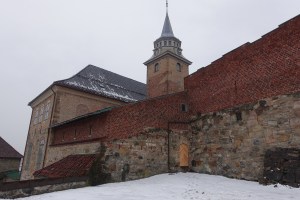 The Akershus Fortress has never been successfully besieged by a foreign enemy. However, in 1940, it surrendered to Nazi Germany without combat. The Norwegian government evacuated the capital when it was unprovokedly assaulted.

Our feet getting wary, we decided to make our last stop for the day before heading back to the hostel to rest our laurels. The Oslo Opera House is uniquely designed such that the roof of the structure angles to the ground level. This creates an elevated plaza that allows pedestrian interaction with the building. Tom and I climbed all the way up and were greeted with a panoramic view of the waterfront.
As a structural engineer,the fact that this roof is merely supported by thin angled columns is intriguing. How, exactly did they analyze the load paths/patterns through the asymmetrical characteristics of the column geometry? The minimalistic framing and specialty glass allows for optimal views of the surrounding water.
 From the roof, and at ground level, we observed the sculpture, “She Lies.” The stainless steel and glass fabrication resembles ice and depicts a symbol of power for the region. As it lays on a transient concrete platform, it is free to turn with the bidding of the tide and the wind. I think the sculpture is a metaphor. For as quick as the tides change and the wind changes direction, so too can the power shift.
P.S. Tom is currently passed out next to me. If anything, my boyfriend could certainly hibernate through a long winter if instinct required it of him. 😛
30 Dec 2014
by PhoenixKaio
in Architecture, Art, Britain, Faith, History, India, Landscape, Myths & Legends, Portugal, Religion, Symbolism, Travel
Tags: Abstract, Aniconism, British Rule, Buddhism, Carvings, Caves, Earthquakes, Elephanta Caves, Elephants, Ganesh, God, Hindu Cosmology, Hinduism, Indian Independence, Shiva, Wisdom, World Elephants
 Elephants are creatures that are revered in India. According to Hindu Cosmology, the earth is supported and guarded by mythical World Elephants at the compass points of the cardinal directions. Sanskrit literature even attributes earthquakes to the shaking of their bodies when the elephants tire of their burden.
The deity Ganesh(a) is the god of wisdom, and he is distinctively represented by a human form with the head of an elephant, which was placed after the human head was either decapitated or burned from the body.
 However, this is not how the Elephanta Caves, with origins dating between the 5th and 8th centuries, received their namesake. In the 16th century, the Portuguese named the island “Elephanta Island” in honor of a huge, monolithically rock-cut black stone of an elephant on a mound; this unfortunately has been relocated to the Mumbai Zoo.

Credit: Nikhil Kulkarni
Despite being just 7 miles east of the port, the ferry ride took an hour to get there! Fortunately, I caught some great views of the Gateway of India, the exit causeway through which the last British troops passed through on February 28, 1948, signalling an end to British rule and the beginning of Indian independence.
In each of the caves, Shiva or Mahadeva, “Great God” is aniconically represented by a Lingam, a single rock rounded at the top. Aniconism is the avoidance of using images to represent divine beings, prophets, and religious figures.
However, I happen to find the monolithic rock to be an appropriate manifestation of Shiva.
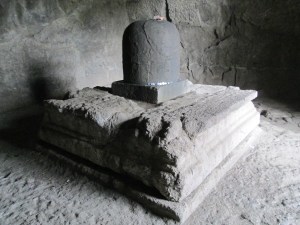
At his highest level, Shiva is considered limitless and transcendent, unchanging and formless. Why not abstractly represent him as something from nature that also adheres to these characteristics? Are rocks not powerful? Do they not withstand the test of the time?
I may not be Hindu, but even I was moved. I couldn’t help but place my palm against the rock and close my eyes, taking some time to summon my faith, and chant the Buddhist Mantra I learned as a child beneath my father’s wing.
28 Dec 2014
by PhoenixKaio
in Architecture, Art, Faith, History, India, Innovation, Natural Beauty, Travel
Tags: Astronomical, Cardinal Directions, Chaumukha, Cold, Inticate, IST, Jainism, Marble, Monsoon Palace, Mumbai, Petite, Ranakpur, Regret, Snares, Udaipur, UNESCO

Our initial plan today was to hire a taxi to day trip to Ranakpur before being dropped back at the airport for our flight to Mumbai later tonight. Unfortunately, our lack of internet connection at the hostel proved to be our downfall.
While I had posited asking the staff for advice on taking buses, Nick didn’t hear me, and I was too snuggled into my cozy cocoon to emerge from the warmth. We did not make it to Ranakpur and I regret not summoning the willpower to face the cold. Admittedly though, it was really nice to have an open day with nothing planned.

Credit: Ingo Mehling
Ranakpur is 91 km away from Udaipur, making it approximately a 1-hour car ride in US terms and a 2.5 to 3-hour travel time according to IST (one needs to factor in traffic, rough roads, and slower speed limits). It is home to a UNESCO World Heritage Site, a massive, sprawling, Jain Temple constructed entirely of marble in 1437.
 It is with sorrow that I cannot speakbout how amazing the structure was, as it has over 1444 pillars that are each uniquely carved in exquisite detail. Additionally, there is a massive rock that is carved into 108 snake heads and tails. The layout of the building is in the form of a chaumukha – four faces in each of the four cardinal directions that symbolize the cosmos.
Instead, Nick went off to meet his Uncle and I found a little cafe to savor coffee in while using their wifi for some net-based tasks. We met up again later that morning to visit Monsoon Palace.

Credit: Nikhil Kulkarmi
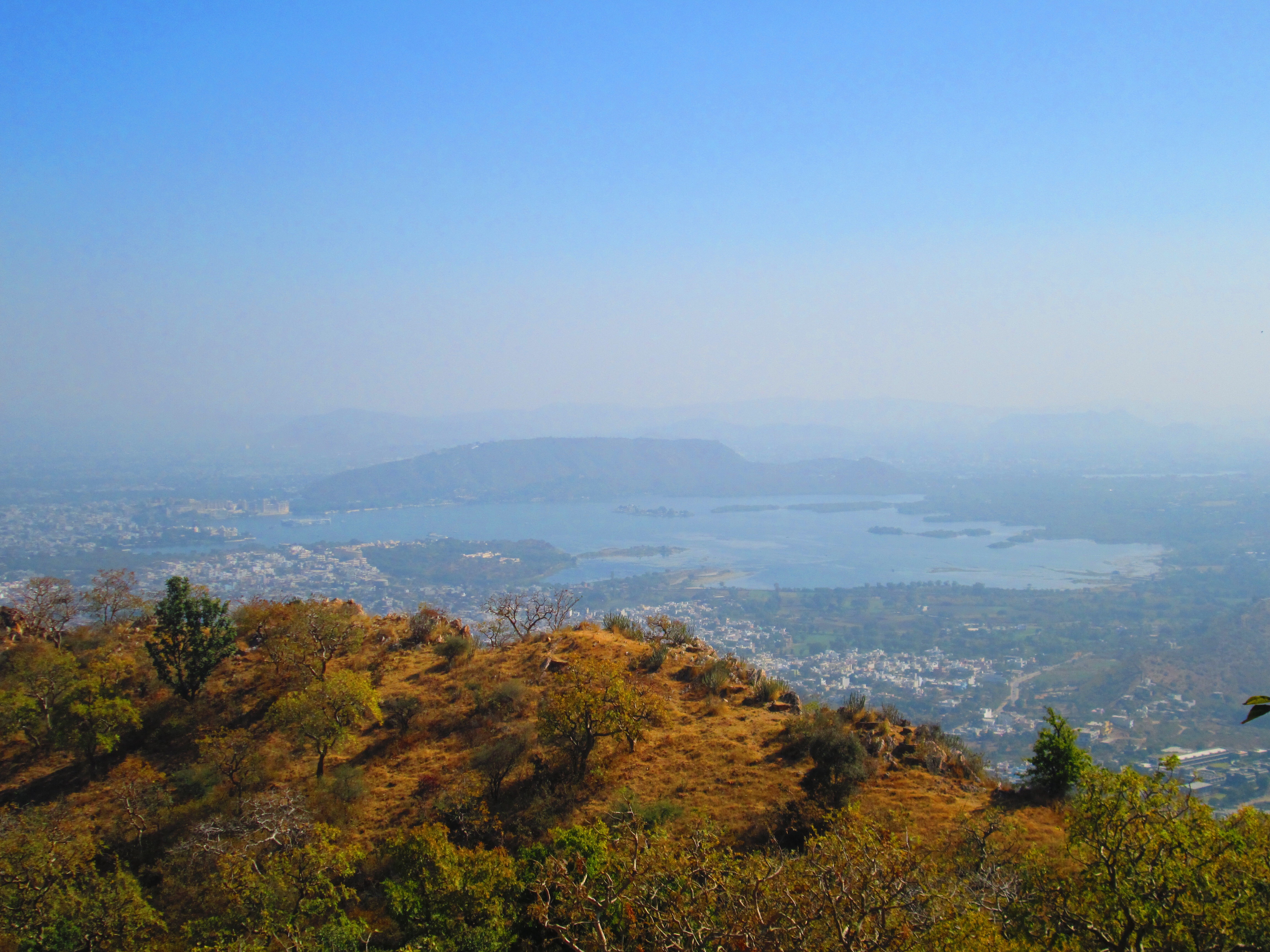
The Monsoon Palace was built in 1884 entirely of white marble on the Bansdara Peak of the Aravalli Hill. At a total elevation of 3100 ft overlooking Lake Pichola, the original intent was for it to be a 9-story astronomical centre to track the movement of the monsoon clouds. It would also be a vacation home for the royal family.
 Unfortunately, despite the innovative water harvesting system the building utilized in its underground cistern, the storage capacity proved to be inadequate resulting in the abandonment of the palace.
After the palace, all we had to do was get Nick a shave for the wedding, and find him some shoes. This was surprisingly almost as difficult as finding me a Saree; there’s not much you can do about a gigantor’s foot size when you are on a continent that tends to produce petite-sized humans.
27 Dec 2014
by PhoenixKaio
in Art, Dance, Family, Handicraft, History, India, Travel
Tags: Camels, Dilli Haat, Folk Dancing, Heritage, Kamar, Manjeeras, Precision, Rhythm, Shilpgram, Technique, Teratali, Tribes, Udaipur
Since Udaipur is a smaller city and Nick and I have already seen our fair share of ancient temples, palaces, and fortresses, we chose to experience the diversity of India by visiting Shilpgram.
Much like the Dilli Haat in New Delhi, Shilpgram is a heritage village composed of 5 west-zone states. Its purpose is to expose the diversity of tribal cultures to the general public and foster a spirit of collaboration between rural and urban artists. This cultural complex was incredibly large with a total square area of 70 acres!
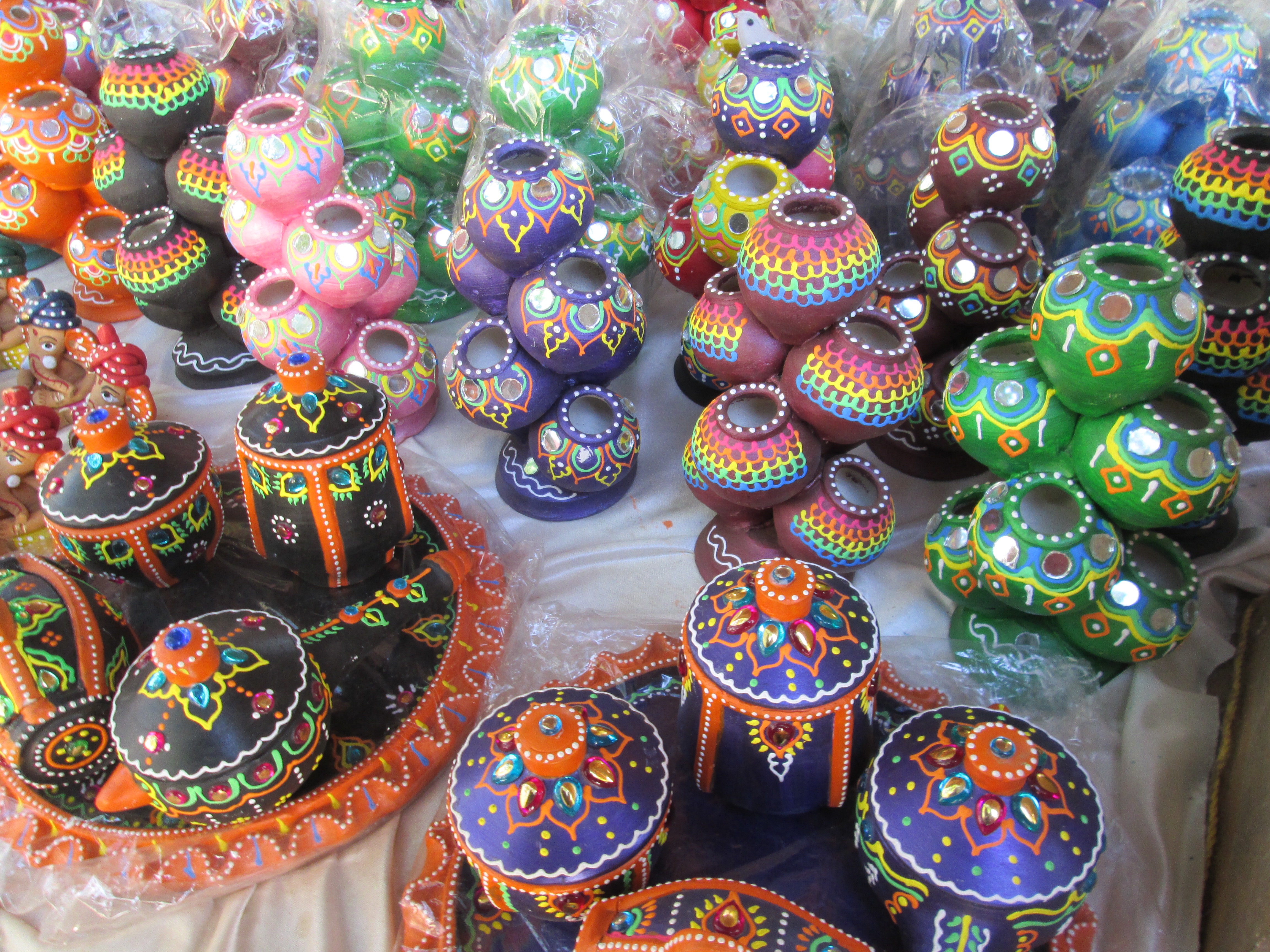
Nick and I didn’t intend to stay for so long, but there was so much vibrancy to be seen amongst the artists. I’ve attached a brief collage below to illustrate the range of work.
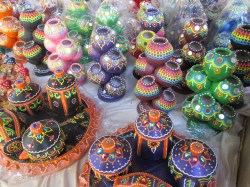


Credit: Nikhil Kulkarni and Myself (some are his and some are mine).

Credit: Nikhil Kulkarni
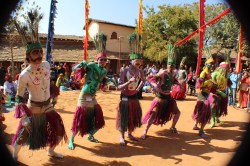
One of the things I enjoyed the most were all of the regional dances that were performed. As someone who studied traditional chinese dance for over 8 years in my youth, folk dancing continues to fascinate me. It is such a rich part of one’s ingrained heritage and it would be a true pity if these arts got lost in the sands of time.

Credit: Nikhil Kulkarni

Credit: Nikhil Kulkarni
Some of the female dancers kept inviting me to join them! I didn’t, but I did pick up the rhythm and pattern of their movements. At the end of it all, they were really friendly and invited me to take a picture with them.

Credit: Nikhil Kulkarni
Nick and I both hopped on Camels and went for a ride as well.
We finished our day with a sunset boat ride on the lake, followed by more famous dances from Rajasthan at the Bagore Ki Haveli.

Credit: Nikhil Kulkarni

Credit: Nikhil Kulkarni
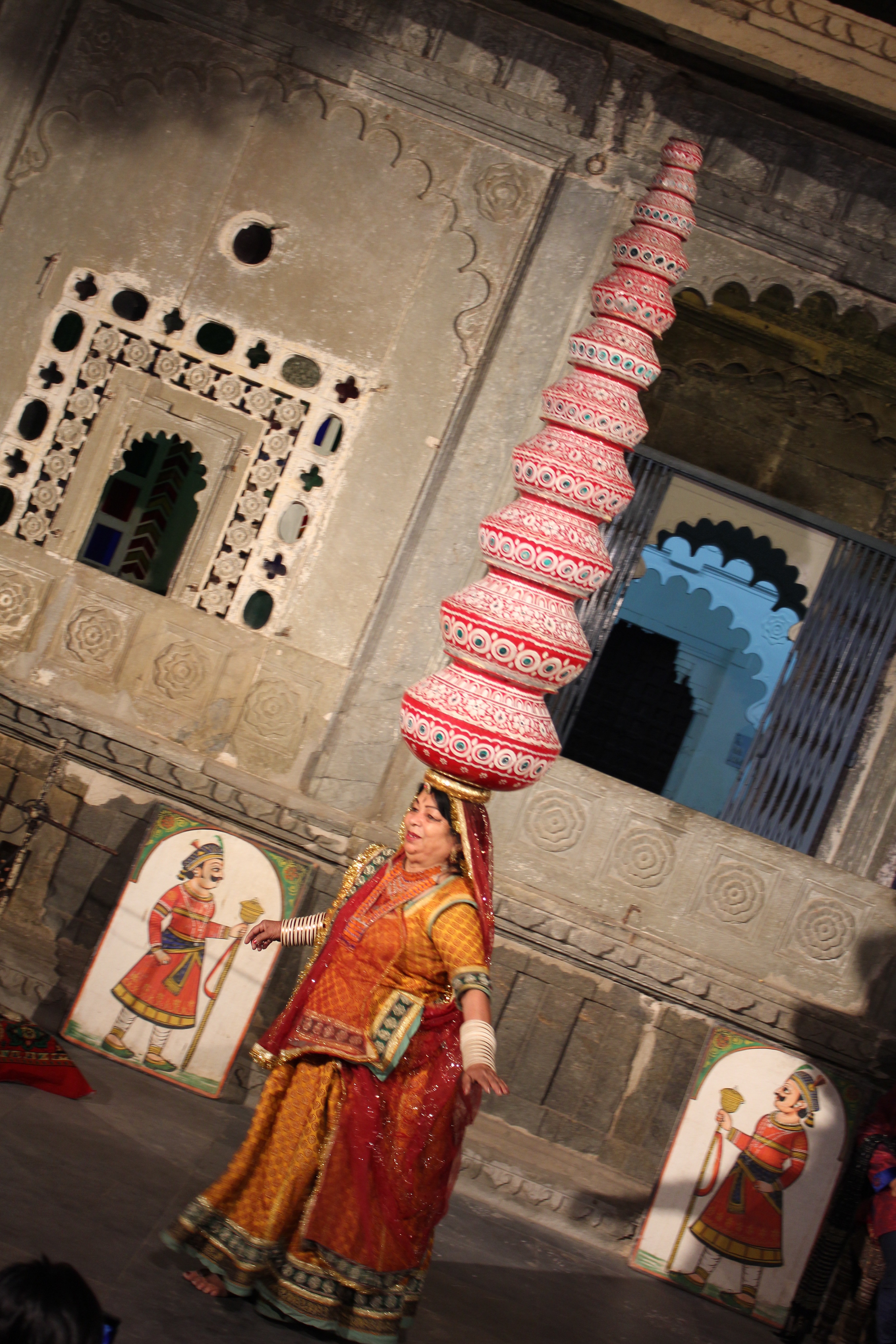
My favorite dance by far was the Teratali dance. Performed by the Kamar tribe while sitting down, the woman balance a pot on their heads and clench a sword between their teeth while they use Manjeeras (cymbals) to acoustically provide thirteen different beats. The sounds made vary by the angles at which the cymbals collide, making this dance one that requires technique and precision.
Unfortunately, the seating area was less than optimal, otherwise I would have provided a video. 😦
26 Dec 2014
by PhoenixKaio
in Architecture, Art, History, India, Myths & Legends, Politics, Travel
Tags: Architectural Blends, City Palace, Desert, First World Problems, Fort, Hermit, Lakes, Maharana, Sleeper, Toilets, Udaipur, Venice
 Nick and I actually delayed our travels to the city of Udaipur by a day because we wanted to visit the Fort. Hence, rather than a 7:30 AM bus, we caught a 6.5-hr sleeper bus. Since it was a non-AC bus, we were feeling pretty optimistic that it would not be too cold. After all, how often does a typical commercial bus have openly ventilated windows? Much to our dismay, even though each cot had its own glass-enclosed cubicle, the windows to open air were not tightly sealed, and therefore it was impossible to limit the amount of penetrating cold desert air.
 Even worse, I woke up at 3 AM with a pressing need to use the toilet, with no possibilities in sight. I was concerned that even if I asked the driver to pull to the side, the language barrier would prevent him from fully understanding that I needed him to wait for me. I was terrified that he’d drive off and leave me, in the desert, by myself, in the middle of the night. A long struggle later, Nick finally woke up, and he made sure the bus driver didn’t leave me behind (though he was concerned when he felt the wheels of the bus inching). 😦 There is never anything glamorous about popping a squat in a dark ally out of sheer necessity.

Credit: Nikhil Kulkarni
When we finally arrived at our hostel around 6 AM, they had given our beds away (even though we had called the previous day to give them fair warning)! Nick and I ended up having to squeeze ourselves into two very small chairs with a blanket to catch a little more shut-eye.
Needless to say, we did not feel very rested when we finally awoke, and had a pretty lazy day.

Credit: Nikhil Kulkarni
Udaipur, often called the “Venice of the East” for the its beautiful lakes, was founded in 1559 by Maharana Udai Singh II as the last capital of the Mewar Kingdom. It was during this time that the City Palace first came into existence. In reality, the City Palace is not merely one palace, rather it is a sprawling complex consisting of many different palaces that were constructed by 76 different kings over the course of nearly 400 years.

Credit: Nikhil Kulkarni
The royal family, the Sisodia Rajputs “Worshipers of the Sun God,” built each palace to face east, in order to greet the rising sun. The exquisite facade of the 11 palaces spans a total length of 800 ft, and a total height of 100 ft. A unique trait of the architecture is that, since the total structure was built over an extended period of time, one can see a diverse blend of different styles. Each characteristic of the Rajasthani, Mughal, Medieval, European, and even Chinese Architecture is paradoxically homogenous and unique at the same time.
It is said that the Maharana (distinct from the term Maharaja) built his palace atop the hill following the advice of a hermit who he had found meditating at the summit.
20 Dec 2014
by PhoenixKaio
in Architecture, Art, Faith, Handicraft, India, Myths & Legends, Religion, Symbolism, Travel
Tags: Albert Hall Museum, Arches, Architecture Movement, Carvings, Colorful, Crafts, Domes, Ethnic Clothing, Handiwork, Hinduism, Jaipur, Rajasthan, Saree

Credit: Nikhil Kulkarni
After our lunch break, we decided to cut through the Bazaar on our way to the Albert Hall Museum. I have never seen as much color as I have in Jaipur. Nick says that the handicrafts of Rajasthan are so vibrant to contrast the muted colors of the desert.
In truth, the aristocrats of Jaipur were avid patrons of the arts. They often coaxed skilled artisans from around India and abroad to settle in Jaipur and make it their home. I’ve included a few pictures below to illustrate the broadness of their crafts.


Credit: Nikhil Kulkarni
 The Albert Hall Museum was designed by Sir Samuel Swinton Jacob in 1887, and exemplifies Indo-Saracenic Architecture. This form of architecture originated in the late 19th century as a movement by British Architects to merge elements from native Indo-Islamic and Indian Architecture with the Gothic and Neo-Classic styles of Victorian Britain. Some of the typical characteristics you may see include: Onion Domes, Scalloped Arches, Minarets, and Domed Kiosks. We decided not to meander too long on the exhibits, because Nick isn’t a fan of museums, and I’m still a little museum-dead from my epic Eurotrip.
Our last stop of the day was the Birla Temple. The temple is dedicated to Lord Vishnu, the preserver, and his consort Lakshmi, the Goddess of Wealth.
 Despite being a “modern” structure, – completed in 1988 – symbolism is still rampantly prevalent in the architecture of the building. Each of the three huge domes of white marble represent the three different approaches to the religion, and intricately stained glass windows illustrate scenes from Hindu Scriptures. Something that is singularly iconic to Hinduism is the acceptance of all other religions. This is demonstrated by the carvings along the exterior walls that depict import figures from both history and other faiths.

Credit: Nikhil Kulkarni
Taking one last glance at the temple as the sunset illuminated it in the background, Nick and I returned to the bazaar in search of a Saree for me. While I don’t typically buy ethnic clothes while I travel, I felt it necessary for this trip as I will be attending a traditional Indian Wedding when we reach Mumbai.
Unfortunately, as is often the case when I am shopping in Asia, we hit some roadblocks in the form of sizing. I found a color scheme and pattern that I loved, but, as Nick would put it, my broad,, manly shoulders made the top a bit too snug. T.T.
20 Dec 2014
by PhoenixKaio
in Architecture, Art, History, India, Innovation, Natural Beauty, Travel, Urban Design
Tags: Air Flow, Ingenuity, Intricacies, Jai Sing II, Jaipur, Lattice Work, Rajasthan, Royalty, Urban Planning, Vastu Shastra, Ventilation
To recap thus far, we have visited the states of Delhi – the capital territory of India – and Madhya Pradesh – “the heart of India” – and are now exploring Jaipur, the capital city of Rajasthan.
 Jaipur was founded by Jai Sing II, the Raja of Amer in 1727. His capitol originally lay 51 km away, but water was becoming scarce, and Jai felt that shifting his city would increase the population. After much deliberation and the architectural guidance of Vidyadhar Bhattacharya, the city was laid-out in accordance with the classic principles of Vastu Shastra. Its core concept centers around urban planning for the comfort of its citizens and the integration of the built environment with nature, while trying to maintain perfect geometric patterns (Yantra), symmetry, and directional alignment.

Credit: Nikhil Kulkarni
The first stop of our day was the Hawa Mahal, “Palace of Winds.” Built in 1799 by the Maharaja Sawai Pratap Singh, the structure was designed by Lal Chand Ustad to form the crown of Krishna. The five-story exterior face is reminiscent of the honeycombs of a beehive, and has 953 jharokhas (small windows) with intricate latticework. Not only did the windows allow royal ladies to observe daily life without being seen, but it also resulted in the Venturi Effect, natural ventilation that helped promote the flow of cool air through the building in the summers.
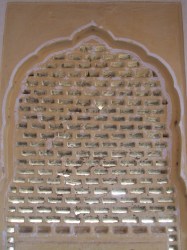 I also noticed that a lot of the window slots slanted downwards. Jaipur, named “The Pink City” because so many of its buildings are painted pink, lies in the desert. The slant of the window perforations allowed residents access to fresh air, without putting them at the mercy of the blazing sun. I found this to be a particularly ingenious idea for being created almost 300 years ago.
We had then hoped to visit the City Palace, but were rebuffed by how expensive it would have been to tour the interior (about 2500 rupees for foreigners with no cameras allowed).
 While the pictures shown at the ticket office were pretty jaw dropping, this price point would have been equivalent to $45! It would have been the most expensive tourist destination I’d ever gone to across every continent and country. At the same time, this is marginally understandable as Rajasthan is one of the few states with present-day Royalty. They only chose to merge with the Indian Union after Indian Independence in 1949.

Credit: Nikhil Kulkarni
Just a few steps away was the Juntar Mantar. You may recall that it has a sister that we visited in Delhi.
18 Dec 2014
by PhoenixKaio
in Architecture, Art, Faith, History, India, Innovation, Landscape, Love, Myths & Legends, Natural Beauty, Religion, Symbolism, Travel
Tags: Ancient, Construction, Detail, Erotic, Geometry, Hinduism, Khajaraho, Life, Mandala, Sandstone, Temple
 *Disclaimer: The photographs contained in this post may not be suited for younger eyes.
This morning, we bid adieu to the chaos and clamour of New Delhi, and hopped a quick domestic flight to Khajaraho for the night.
Khajaraho lies 385 miles southeast of New Delhi and is home to a mere population of 20,000 people. It was the seating ground of the Chandela Dynasty which ruled much of the Bundelkhand region of central India between the 10th and 13th centuries.
 The name Kharjuravāhaka is derived from ancient Sanskrit (kharjura, खर्जूर meaning date palm, and vāhaka, वाहक meaning “one who carries” or bearer). As the legend goes, there was once two golden date-palm trees at the gate of the temples. Kharjuravāhaka also has another meaning in Desai, scorpion bearer; this is a symbolic name for the deity Shiva, who bears snake and scorpion garlands upon his shoulders. This is fitting, as Khajuraho is one of four holy sites linked to Shiva. Hindu mythology recognizes the town as the location of his marriage.
 In its prime. Khajaraho had 85 temples spread over 20 square kilometers. Today, there are only 12 temples spread over 6 kilometers. As is typical with Hindu temples, they are clustered near a body of water and face east, towards the sunrise. Each temple integrates the interdependence between feminine and masculine deities and highlights the four goals of life – Dharma, Kama, Artha, and Moksha.
 Like most Hindu temples, these temples follow a grid geometrical design called vastu-purusha-mandala, which has three important components. Mandala meaning circle, Purusha conveying universal essence, and Vastu meaning a dwelling structure.
This is displayed by the geometric use of squares and circles. A square, divided into 64 perfect sub-squares (padas) circumscribe the circle of mandala. The square is considered divine and represents the product of knowledge and human thought while the circle, considered earthly, symbolizes everyday life.
 To further illustrate the comprehensive design of the site, the Chandela’s laid out the territory in three triangles, which converge to forma a pentagon. The three triangles represent the three realms (trilokinatha) and the five-side pentagon, indicates the five cosmic substances (panchbuteshvara).

For me, the most interesting thing about the temples, is that the sandstone blocks aren’t glued together with mortar. Rather, in a fashion similar to classic Chinese wood construction, each mortise and tenon was precision cut so that the male piece could interlock with his female counterpart, allowing gravity to keep them joined.
We decided to take this side trip primarily because the temples are best known for the erotic carvings that adorn the faces.
 However, these sexual figures only account for about 10% of the detailing on the temples, and are not prominent nor emphasized compared to the others. It was a bit of a “Where’s Waldo” scavenger hunt, as we went searching for these. Other sculptures depict the numerous aspects of human life and the values vital within the Hindu Pantheon.
Some of the positions just didn’t seem humanly possible! Although, given that the art of Yoga was developed in Ancient Pre-Vedic India between 5th to 6th century BC, perhaps our ancestors possessed a depth of flexibility that current humans do not.
17 Dec 2014
by PhoenixKaio
in Architecture, Art, Faith, Family, History, India, Landscape, Love, Myths & Legends, Natural Beauty, Politics, Symbolism, Travel
Tags: Agra, Commitment, Craftsmanship, Death, Dedication, Emotion, Intricate, Loss, Marble, Mausoleum, Memories, Mughal Empire, Shah, Taj Mahal, Tribute, World Wonder
We woke up at 4 AM today, because we needed to catch the 6 AM Shatabdi Express – India’s Fastest Train – to Agra for a day trip. Needless to say, it was a long day as our transit time was 2-hours one-way, assuming that everything is executed flawlessly.

Credit: Nikhil Kulkarni
Agra, a former cantonment of the British empire, is the home of the Taj Mahal, one of seven wonders of the world. It is an eye-catching structure consisting entirely of white marble and its impossible to miss the light reflecting off of its surface as the sun creeps higher in the sky.
Its origin story is one of love, despair, and tragedy.
 In the 17th century, Shah Jahan, one of the Mughal Emperors, lost his third wife, a Persian princess named Mumtaz Muhal during the birth of their 14th child in 1631. The following year, construction of the Taj Mahal began. Over the course of 20 years, this project enlisted the labor of over 1,000 elephants to transport building materials from all over India and Asia. In addition to the iconic white marble that the building is known for, 28 other types of precious and semi-precious stones were inlaid into the ornate design.

As this was a period of prosperity within the empire, a skilled labour force of twenty-thousand workers were recruited from all across India. A total of 37 men were selected to form the creative unit behind the Taj Mahal.
There were sculptors from Bukhara, calligraphers from Syria and Persia, inlayers from southern india, stonecutters from Baluchistan, and individuals who specialized in everything from turrets to the carving of marble flowers.

Credit: Nikhil Kulkarni
Not too soon after the Taj Mahal’s completion, the Shah was deposed by his son, Aurangzeb, and imprisoned at Agra Fort. It is said that he was given a cell with a window facing the Taj so that he could gaze at the resting place of his love. Shah Jahan was later buried in the mausoleum next to his wife.

As a young professional trying to balance the scales of career and ambition between passion and family in the 21st century, it is difficult to imagine the depth of emotion, much less, the hollow shadows that the Shah must have felt on his wife’s passing.

I feel that so much of my generation tends to trivialize the word love, that it’s merely a word to convey feeling, but the term amor speaks volumes more. It means depth of commitment, being willing to compromise, accepting the flaws of your significant other, and most of all, not giving up on your relationship when things get rough. You have to be willing to fight for it.
That’s what Shah Jahan did. Although Mumtaz was long gone from the world, she stayed alive in his memory. He wanted to commemorate her significance in his life, and the empty space left in his world by her departure.
The Taj Mahal was truly a tribute to the joy they shared.
 Not too far away, is the Agra Fort, a towering fortress where the throne-less shah was held captive. A fort has stood at this location since the 11th century, although the current structure was built by the Mughal Empire. Spanning a total area of 94-Acres, the red sandstone is a staunch guard that dominates the skyline.
As the stories say, Shah Jahan was actually held in the Muasamman Burj, a tower with a marble balcony facing the Taj Mahal.

After our visit to the fort, it was time to catch our train home. This took a large amount of patience as, despite our 6 PM tickets back, our plane was consistently delayed. First it was by 40 mins, and then it was 1-hour. This soon changed to a 2-hour delay, and progressed further to a 3.5-hour delay. Eventually, we bought another set of tickets for the Shatabdi Express (which is always on time), and managed to get back to Delhi around 11:30 PM. Whew!
16 Dec 2014
by PhoenixKaio
in Architecture, Art, Faith, History, India, Landscape, Myths & Legends, Politics, Quotes, Religion, Symbolism, Travel
Tags: Akshardham, Craftmanship, Delhi, Emperors, Hinduism, Inspiration, Mahatma Gandhi, Marble, Pilgrimage, Sandstone, Tombs, World Leaders, Yogi
The one thing about traveling in a foreign country whose citizens are predominately one ethnicity or skin tone, is the complete incapacity for me to blend in. Much like a blonde friend of mine who studied abroad for a semester in Hong Kong, I am a curiosity to the locals. More so an anomaly, because it seems that East-Asians do not often visit India.

Credit: Juthani1
It is a little strange to feel eyes on oneself everywhere I go. This was best exemplified today when we went to visit the Akshardham. A toddler baby pulled my hair as we were going through security, and an entire school trip of boys all shouted hello and goodbye as we walked past their orderly line. One even ran up to me to shake my hand.
. . .If only they had been a few years older, it would have certainly been a major ego boost. 😛
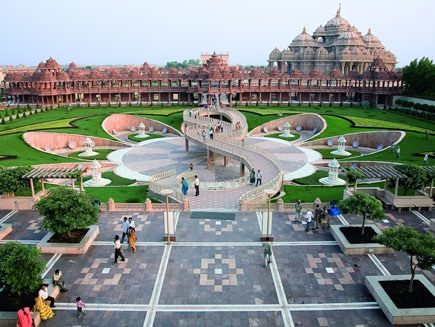
The Akshardam is a massive complex with a Hindu temple, devoted to Swaminarayan as its central focal point. Swaminarayan is the founder of one of the sects of Hinduism. Originally born in Chhapaiya, Uttar Pradesh, India in 1781, he began a 7-year pilgrimage across the country on June 29, 1792 at the age of 11 after the death of his parents.

Credit: Juthani1
He traveled across India and Nepal in search of an ashram that practiced what he considered to be the correct understanding of Vedanta, Samkhya, Yoga, and Pancaratra, the four primary schools of Hindu philosophy.
Finally, in 1799, Swaminarayan’s travels as a yogi concluded in Loj, where he stayed as a disciple of Ramanand Swami, and took over leadership as guru after Ramanand died. Swaminarayan passed away on June 1, 1830.
The Akshardham, although a more recent structure that was just completed in 2005, is designed according to ancient Vedic text, and features a blend of architectural styles from across India. It is not supported by steel nor concrete, but is constructed entirely from Rajasthani pink sandstone and Italian Carrara marble. Pictures can’t even begin to illustrate the ornate detail and craftsmanship that was invested into each microscopic niche of the temple. It’s truly an awe-inspiring piece of architecture.

Credit: Stanislav Sedov and Dmitriy Moiseenko
To quantify, the main monument is 141 ft high, 316 ft wide, and 356 ft long. There are 234 intricate pillars, 9 domes, and 20 0,000 murtis and statues of Hinduism’s sadhus, devotees, and acharayas. It also contains 148 scale-sized elephants. This total building weighs a massive 3000 tons.

Credit: Nikhil Kulkarni
In stark contrast to the elaborate and jaw-dropping Akshardham, Raj Ghat is understated and simple, as one would expect of the burial place of Mahatma Gandhi. Its difficult not to be overwhelmed by the legacy this great man left behind.
Not only did he free his nation through peace, but he also inspired countless movements across the world. You can see his influence span from the American Civil Rights Movement to the Occupy Wall Street Moment. So many of the leaders we admire today have used Gandhi as there guiding light, Martin Luther King, Cesar Chavez, Nelson Mandela, and the Dalai Lama are but a few.

Credit: Nikhil Kulkarni
Our last stop of the day was Humayan’s Tomb, the inspiration behind the Taj Mahal, and the resting place of Emperor Humayan.
I shall leave you with one of my favorite quotes:
“Be the Change you wish to see in the world” ~ Mahatma Gandhi.
Previous Older Entries Next Newer Entries
 Making use of one of the barista’s recommendations, we ventured towards Aker Brygge, a unique, waterfront development that was completed in 2014. It was formerly the site of a shipyard and industrial buildings. Vingen, a restaurant attached to the Astrup Fearnley Museet was difficult to find, but incredibly tasty! Tom had the Eggs Benedict, while I had their version of a Katz Pastrami Sandwich.
 After a brief break, we ventured back into the cold to explore the history of the Akershus Fortress. Construction of the fortress is believed to have started around 1290 when King Hakon V realized that the city needed a stronger defense center than that which currently existed. Since it lied adjacent to the sea, it allowed Norway to prosper commercially while providing the nation with a strong military presence.
  The Akershus Fortress has never been successfully besieged by a foreign enemy. However, in 1940, it surrendered to Nazi Germany without combat. The Norwegian government evacuated the capital when it was unprovokedly assaulted.
 From the roof, and at ground level, we observed the sculpture, “She Lies.” The stainless steel and glass fabrication resembles ice and depicts a symbol of power for the region. As it lays on a transient concrete platform, it is free to turn with the bidding of the tide and the wind. I think the sculpture is a metaphor. For as quick as the tides change and the wind changes direction, so too can the power shift.












 CestLaJu