Oslo: Ashes of Vikings

The one thing Tom and I do every morning is to take some time to savor a good cup of coffee. We are both aficionados of this savory drink, and it’s a great way to to warm us up from the inside out before we venture off to galavant about a city blanketed in snow. 

Since our legs and feet were so tired from walking about 10 miles yesterday, we decided today would be a museum day. Specifically, we would pass our time by visiting the museums on the Bygdøy Peninsula, an area that still maintains its rural vibe, and houses the Oscharshall Palace, the summer home of the Norwegian Royal Family.

 Our first stop was the Norwegian Folk Museum, an open-air museum that has many traditional buildings on site that allow you to explore the daily lifestyles of Norwegians from the 16th century and onwards. They also had a few exhibit halls that displayed typical wardrobes and furniture from these eras. The primary reason I wanted to visit however, was to see the Gol Stave Church.

 This one is from 1212, meaning that its over 800 years old! Stave churches were medieval Christian churches that developed in Northern Europe. The name for this type of structure is derived from the Old Norse term “stafr,” meaning the type of timber framing where load-bearing ore-pine posts support lintels. It’s a descendent of palisades construction from the Viking Age. Logs were split into two halves, driven into the earth, and a roof erected over it. 

 The Gol Church falls under a smaller sub-category called the Borgund Group. The stability of the structure is further enhanced by cross-bracing that joins the upper and lower beams and posts. This essentially creates a truss which allows for the weight of the building to be transferred into the ground without the need for intermediate posts, creating a wider, more open, interior space. 

Next, we stopped by the Viking Ship Museum, because what visit to Norway would be complete without getting the chance to learn about Viking history? 


Oslo: City of Tigers II

In 1870, Bjørnstjerne Bjørnson wrote a poem titled , “Sidste Sang”. In it, he illustrates a dramatic fight between a horse and a tiger. The tiger, metaphorically represented the dangerous city, while the horse symbolized the security of the countryside. This is where he first referred to Oslo as Tigerstaden, which represented his perception of the city as a cold and dangerous place. 

 This has not been the case for Tom and I. We have found this snowy, northern city to be warm and friendly. Our barista from earlier this morning graciously gave us a list of restaurants to eat at, and even attempted to teach me the word for “thanks” in Norwegian, “Taak”. (I hope I haven’t been butchering the word too much, but I always like to learn how to say “please” and “thank you” when I travel. I’ve found it is a simple way to show your enthusiasm for the local history and, even though they may laugh, the locals often appreciate your effort.) 

 Making use of one of the barista’s recommendations, we ventured towards Aker Brygge, a unique, waterfront development that was completed in 2014. It was formerly the site of a shipyard and industrial buildings. Vingen, a restaurant attached to the Astrup Fearnley Museet was difficult to find, but incredibly tasty! Tom had the Eggs Benedict, while I had their version of a Katz Pastrami Sandwich.

 After a brief break, we ventured back into the cold to explore the history of the Akershus Fortress. Construction of the fortress is believed to have started around 1290 when King Hakon V realized that the city needed a stronger defense center than that which currently existed. Since it lied adjacent to the sea, it allowed Norway to prosper commercially while providing the nation with a strong military presence. 

 The Akershus Fortress has never been successfully besieged by a foreign enemy. However, in 1940, it surrendered to Nazi Germany without combat. The Norwegian government evacuated the capital when it was unprovokedly assaulted.

  
Our feet getting wary, we decided to make our last stop for the day before heading back to the hostel to rest our laurels. The Oslo Opera House is uniquely designed such that the roof of the structure angles to the ground level. This creates an elevated plaza that allows pedestrian interaction with the building. Tom and I climbed all the way up and were greeted with a panoramic view of the waterfront.

As a structural engineer,the fact that this roof is merely supported by thin angled columns is intriguing. How, exactly did they analyze the load paths/patterns through the asymmetrical characteristics of the column geometry?  The minimalistic framing and specialty glass allows for optimal views of the surrounding water. 

 From the roof, and at ground level, we observed the sculpture, “She Lies.” The stainless steel and glass fabrication resembles ice and depicts a symbol of power for the region. As it lays on a transient concrete platform, it is free to turn with the bidding of the tide and the wind. I think the sculpture is a metaphor. For as quick as the tides change and the wind changes direction, so too can the power shift.  

P.S. Tom is currently passed out next to me. If anything, my boyfriend could certainly hibernate through a long winter if instinct required it of him. 😛

Oslo: City of Tigers


We started off our day with a latte and cappuccino from Tim Wendleboe. Its known as one of the best places to get coffee in Oslo, and also serves as a micro-roastery and training center for all things related to the art of coffee. Tim has claimed multiple championship titles including that of “World Barista Champion.” Tom, the coffee conossieur, said that it was probably the best coffee he has ever had, and I’d have to agree.  

Walking further south to the historic city center, we passed Damstredet, a street that has preserved the charming, small town character of Oslo with its pedestrian-only access and wooden houses. Unfortunately, since it was snowing, the sloping drive up to it simply seemed too precariously slippery to the both of us.  

We spent our afternoon strolling around Old Oslo and passed the Storting Building (Parliament). Oslo’s parliament was established in 1814, but it was not until 1836 that a government proposal was approved for the construction of a permanent building. The location of this structure was finalized in 1857, and a competition was held for the architectural design.  Even though Heinrich Ernst Schirmer and Wilhelm von Hanno won, their proposal looked to much like a church and was thus struck down. Eventually, Swedish architect Emil Victor Langlet was chosen, and the parliament moved into their new permanent residence on March 5, 1886. In 1860, the building cost 957,332 NOK to construct. That’s $31.3 Million dollars in present day value!


Coinciding with our trip, is the 2016 World Biathlon Championship, so we strolled through a pop-up market celebrating this event with kids participating in mini-versions, and were even able to take a picture with the mascot. 

Next, we passed the Nobel Peace Center which celebrates the history of this prestigious award. Ironically, Alfred Nobel, is the inventor of dynamite, and it was a premature obituary condemning him for profiting from the sale of arms, that inspired him to establish the Nobel Prizes. 

It is in the adjacent City Hall that Malala Yousafzai was awarded the Nobel Peace Prize on December 10, 2014. You may recall her as the brave girl that fought for a female’s right to education in Pakistan, was subsequently targeted with an attempted assassination by the Taliban, and after achieving a full recovery, continues to promote her message around the globe. “One child, one teacher, one pen and one book can change the world.”

Journey to Norway

At last, we have arrived! Norway has long been a place that I have only dreamed of. From the glacier-made fjords to the rolling mountains, and, further north above the arctic circle, the aurora borealis waits for us. This nation is rich in its Norse history, and Tom and I look forward to exploring more of it. 

 With a total travel time of 15 hrs, it was not surprising that both Tom and I were exhausted by the time we arrived to our hotel in Oslo. Both of us promptly passed out at 3 pm intending to wake up an hour later, but dutifully failed. We ended up not waking up until 8 pm! Unfortunately, it was far too late to do much exploring, so we merely took a 15 minute walk to try the “Voted best kebab in Oslo.”

 
I should have made an executive decision when I saw the size of one after the girls in front of us put in an order. I didn’t realize that Tom didn’t see how large the servings were. Neither of us managed to finish our portions, so we brought them back to our room to save for later in the fridge.

Travel: Waterfall Safari and Spices

A group of us woke up early today to embark on a day trip beyond the beaches. After all, there is only so much beach bummage that one can handle!

It took us about 2-hours by taxi to reach the the the small town of Kulem, a town located just outside the Bhagwan Mahaveer Sanctuary and Mollem National Park, a protected area located within the Western Ghats.

What I didn’t know at the time is that the Western Ghats are a UNESCO World Heritage Site, and said to be one of eight “hottest hotspots”of biological diversity in the world. The mountain range is home to 39 properties in total with locations in Kerala, Karnataka, Tamil Nadu, and Maharashtra.

From there, we hopped in a safari jeep for a 1-hr climb through the mountains up to the waterfalls.

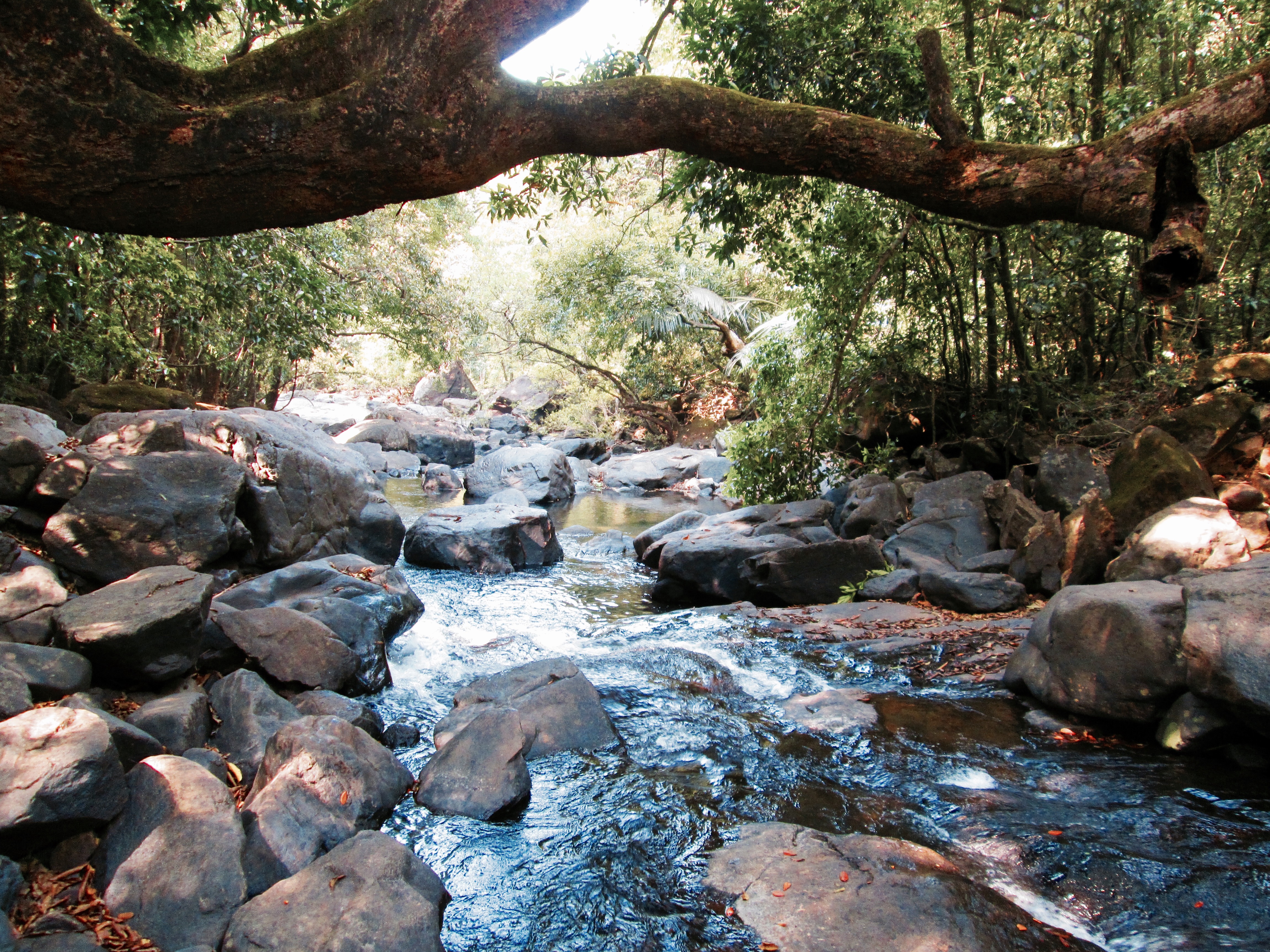
As expected, the 4-wheel drive was more than needed as we climbed the mountain. We crossed over rocky terrain, small streams, and large pools of water at low points along the road. We parked and then there was a short hiking path to the base of the falls.

Dudhsagar Falls is one of India’s largest waterfalls with a peak height of 1017 ft. It sits on the border of Goa and Karnataka, and is a four-tiered waterfall. Its name can be translated to “Sea of Milk” because the monsoon rains transform the entire rock face into a jaw-dropping force of water. Unfortunately the monsoon season is from July to September, so we were just catching the remnants of water left behind.

I wasn’t aware that we were allowed to swim in the pool. Fortunately Tané had a spare bikini top and I decided to sacrifice my underwear for the cause. (I ended up having to ride home commando, wet panties in a pair of jean shorts is never a good idea.)

It was definitely an experience being able to lay our backs against the rock face and feel the pounding of the water run across our heads and shoulders.

We then swam back to the rocks, dried off, and had a quick photo-op before heading to take the jeep back down the mountain. After we hopped in the taxi, it was on to our next stop for the day.

The diversity of India’s culinary creations are something that no one should skimp out on. India is the largest democracy in the world, and its substantial geographic presence results in six, unique climate subtypes. From north to south an abundance of dish varieties can be found. Goa, for example, is well known for its Goan Fish Curry, and the south for its use of lentils, rice, and dosas, whereas naan, rotis, and samosas originate from the north.

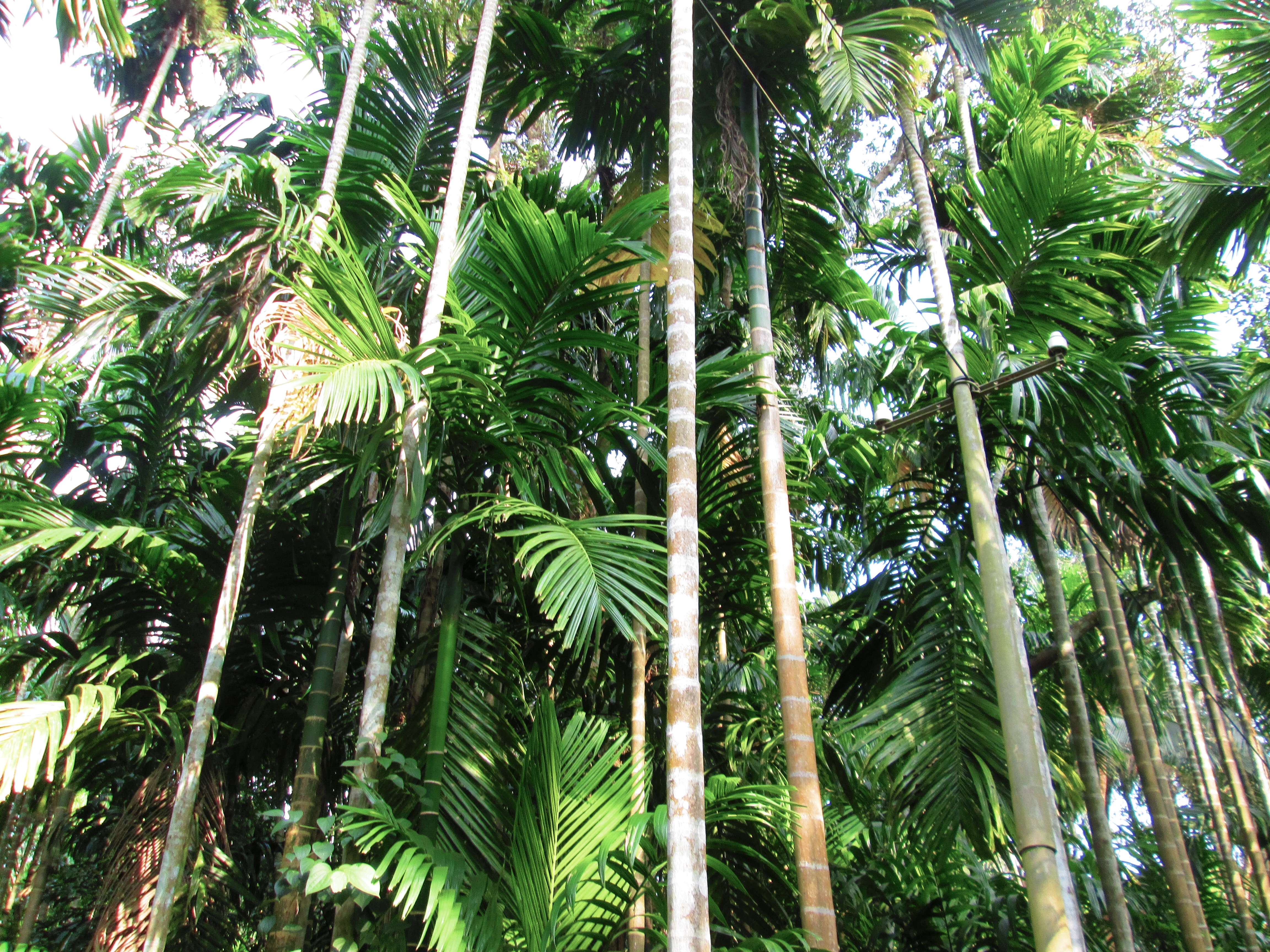
Such variety would not be possibly without the use of spices, and we learned all about the difference flavors that each spice can add to dish on our tour of the Tropical Spice Plantation. We were able to see, pick, and taste all of the following: Pepper, Vanilla, Betel Nuts, Cardamom, Lemongrass, Piri Piri, Nutmeg, Cashew, Clove, Cinnamon, Bay Leaves, Chinese Coriander, Turmeric, Ginger, All  Spice, Gherkin, Cardamom, and Black Cardamom.

imageThey even had an elephant giving rides! (Although I can’t comment on whether he was being ethically treated and cared for.)  We then headed back to the hostel to relax for a bit before we all grabbed dinner together to celebrate my last evening in Goa.

Travel: Beach Bummage 

I have nothing of consequence to note. Haha. As much as I love the backpacking culture of seeing and experiencing as much as possible within a limited timeframe I’d be lying if I didn’t say that it is EXHAUSTING. Traipsing around Central and Southern India with a friend that was native born-and-raised in Bombay has been uniquely authentic, but I am due for some serious R&R!

image

The exciting think about today is that a group of us from the hostel spent the evening exploring the Arpora Night Market. For me, it was very remniscient of Taiwan’s night markets, with stalls offering anything you could possibly want, in addition to the quintessential souvenirs.

image

The market sprawls over a large outdoor are and is only active and open during the main tourist season. Divided into a Lower, Central, and Upper Field, it is difficult not to get lost and overwhelmed by the crowds.

We browsed everything from traditional handicrafts to huge assortments of spices and teas. There were booths after booths brimming with Kashmiri carpets, Pashmina scarves, silver jewelry, and unique art creations. You name it and you can find it! There is also a food court centered around a stage that hosts an array of live music from Rock to Indian Classical.

image

I was both overwhelmed and in awe. It is impossible to miss the fervor in the air, and although similar to previous night markets I experienced as a child, the Arpora Night Market had its own distinctive character. It offered the diversity of a global experience without overshadowing the unmistakeable hints of a typical Indian Bazaar.


Travel: Vagator

This morning with a heavy heart I had to bid Nick adieu. But before he disappeared into the wind, he helped me secure a rigshaw to ferry me away to a hostel for the remainder of my time in Goa. Nick then hopped into a Taxi headed to the airport.

imageIt’s somewhat surprising that we are such good friends, with very similar travel philosophies, despite our colored past. You see, once upon a time, many years ago, we dated each other, and, as with many high school relationships, it ended dramatically and emotionally, igniting a rift in our social circles. But, as is typical with age and college, our friendship evolved and adapted to the adults we were becoming. Even today I still find some irony in our story. Nick is one of a handful of friends that sees the world and travels in similar fashion to myself.

image

But enough about our history! I am now on my own, savoring the rest of my days on Vagator Beach. Unfortunately, with the New Year’s traffic it took me over an hour to get to my new crash pad.By the time I had checked in and dropped off my luggage I was hot, sweaty, and tired. I used the lounge area to catch up on some blog posts, and after recooperating some energy, made the 10-minute walk to check out the beach before calling it a day.

image


Travel: New Years

Last night while walking amongst the crowds on the beach and celebrating the holiday, my butt got grabbed twice. The first time I thought it was an accident, but the second time I couldn’t help myself from turning around and shoving the guy behind me. Nick, ever a great guy friend, backed me up and the group of males backed off. It took me awhile to shake it off and go back to enjoying the celebratory atmosphere.

img_0215-1

img_0212-1

image


This morning, Nick and I slept in. We started off our morning with lunch consisting of traditional Goan Fish Curry and Fried Prawns. It was so tasty! After, we meandered on to the local beach and rented cots for the day to spend a lazy afternoon. We enjoyed quick massages from a peddler, and certainly couldn’t skip our daily tradition of Chai and Biscuits.

With a twinge of sadness we watched the sun dip below the horizon. This was to be Nick and I’s last night together as he was flying out in the morning to spend some time with his extended family in India. We celebrated our eye-opening Indian Adventure together by sharing one last dinner.

image

Travel: Goa

I had a generally unproductive day today. Nick went off to visit some family that he had in Mumbai and although I had time to go explore before meeting him at the airport, I decided to let myself have a lazy morning.

My original intent was to catch up on some blog posts but I found myself mesmerized by a new book I was reading on my kindle.

I caught a taxi to the airport after I checked out after noon. There, I waited for Nick to arrive after a lunchtime meeting with his uncle. When he hadn’t arrived by 1:30 pm, I had a brief panic moment that we had missed each other. This was compounded by my schizophrenic cell phone issues. Fortunately, he was just running late, and I didn’t have to deal with all his luggage on top of my own.

We arrived in Goa around 6 pm, however, it took us about 2 hrs to taxi to our hotel because of how large the state is and the New Year’s Eve traffic. After we settled in, we rented a moped and went in search of dinner, I was surprised by how many Russians were on holiday there!

Goa has a history dating back as far as 20,000 to 30,0000 years. There are still rock art carvings that demonstrate the earliest traces of human life when our ancestors first began to transition from four legs to two legs.

Modern day Goa however can be traced back to the year 1510. It is at this point in history that that the Portuguese defeated the reigning sultan and claimed the region as a settlement. Portuguese sovereignty in present-day India would last for four and a half centuries until 1987, when, in the advent of claiming their independence from the British in 1947, the Indian Army moved to reclaim the territory that was rightfully theirs.

Goa is now one of the richest states of India, with the highest GDP per capita (2.5x the entire country’s), and an average growth rate of 8.2%! It is famous for its beaches and nightlife, which is exactly why Nick and I chose to spend our New Years Eve here.

Travel: Elephants

imageElephants are creatures that are revered in India. According to Hindu Cosmology, the earth is supported and guarded by mythical World Elephants at the compass points of the cardinal directions. Sanskrit literature even attributes earthquakes to the shaking of their bodies when the elephants tire of their burden.

The deity Ganesh(a) is the god of wisdom, and he is distinctively represented by a human form with the head of an elephant, which was placed after the human head was either decapitated or burned from the body.

imageHowever, this is not how the Elephanta Caves, with origins dating between the 5th and 8th centuries, received their namesake. In the 16th century, the Portuguese named the island “Elephanta Island” in honor of a huge, monolithically rock-cut black stone of an elephant on a mound; this unfortunately has been relocated to the Mumbai Zoo.

Credit: Nikhil Kulkarni

Credit: Nikhil Kulkarni

 Despite being just 7 miles east of the port, the ferry ride took an hour to get there! Fortunately, I caught some great views of the Gateway of India, the exit causeway through which the last British troops passed through on February 28, 1948, signalling an end to British rule and the beginning of Indian independence.

In each of the caves, Shiva or Mahadeva, “Great God” is aniconically represented by a Lingam, a single rock rounded at the top. Aniconism is the avoidance of using images to represent divine beings, prophets, and religious figures.

However, I happen to find the monolithic rock to be an appropriate manifestation of Shiva.

image 

At his highest level, Shiva is considered limitless and transcendent, unchanging and formless. Why not abstractly represent him as something from nature that also adheres to these characteristics? Are rocks not powerful? Do they not withstand the test of the time?

I may not be Hindu, but even I was moved. I couldn’t help but place my palm against the rock and close my eyes, taking some time to summon my faith, and chant the Buddhist Mantra I learned as a child beneath my father’s wing.

Previous Older Entries Next Newer Entries