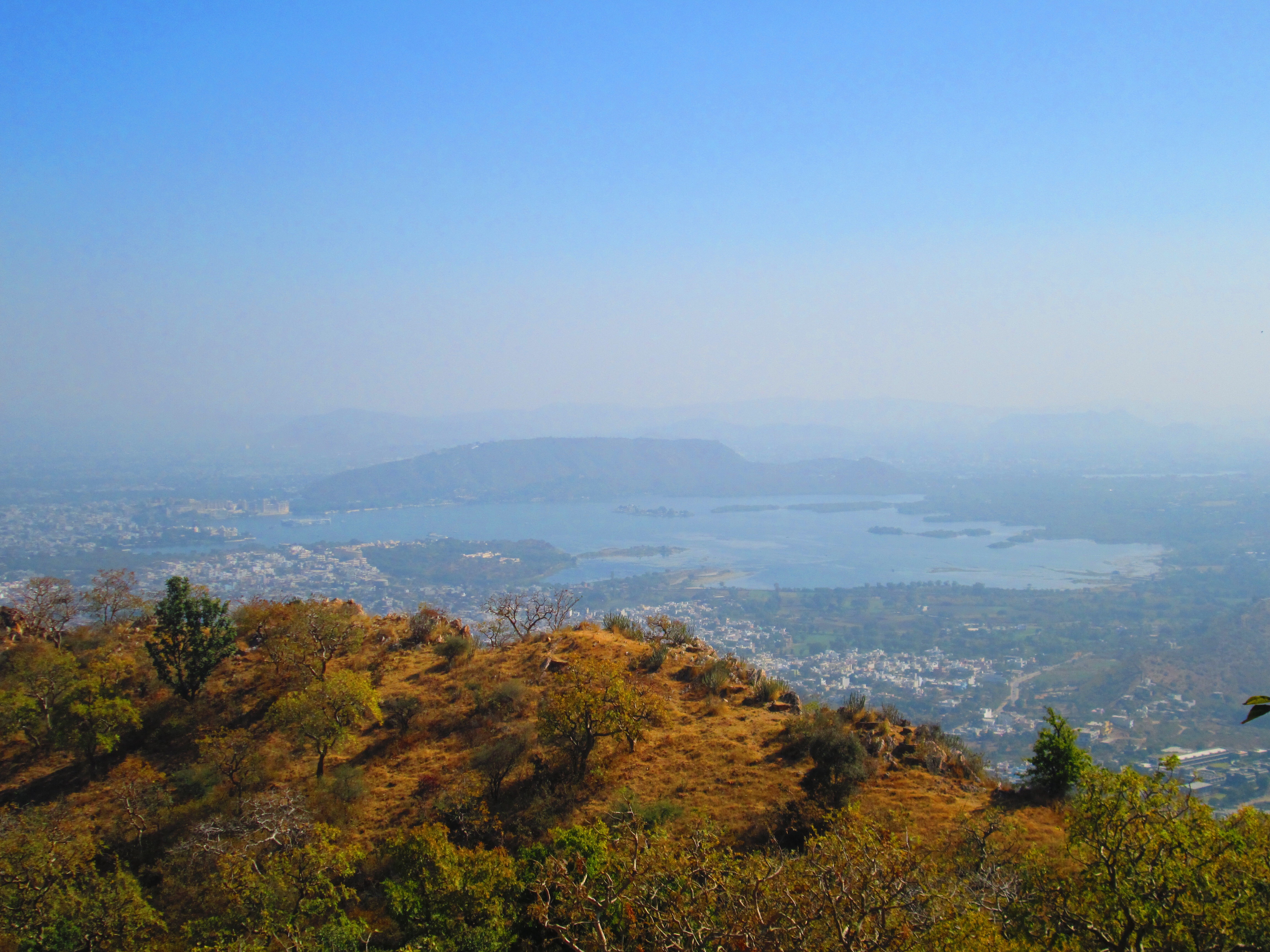
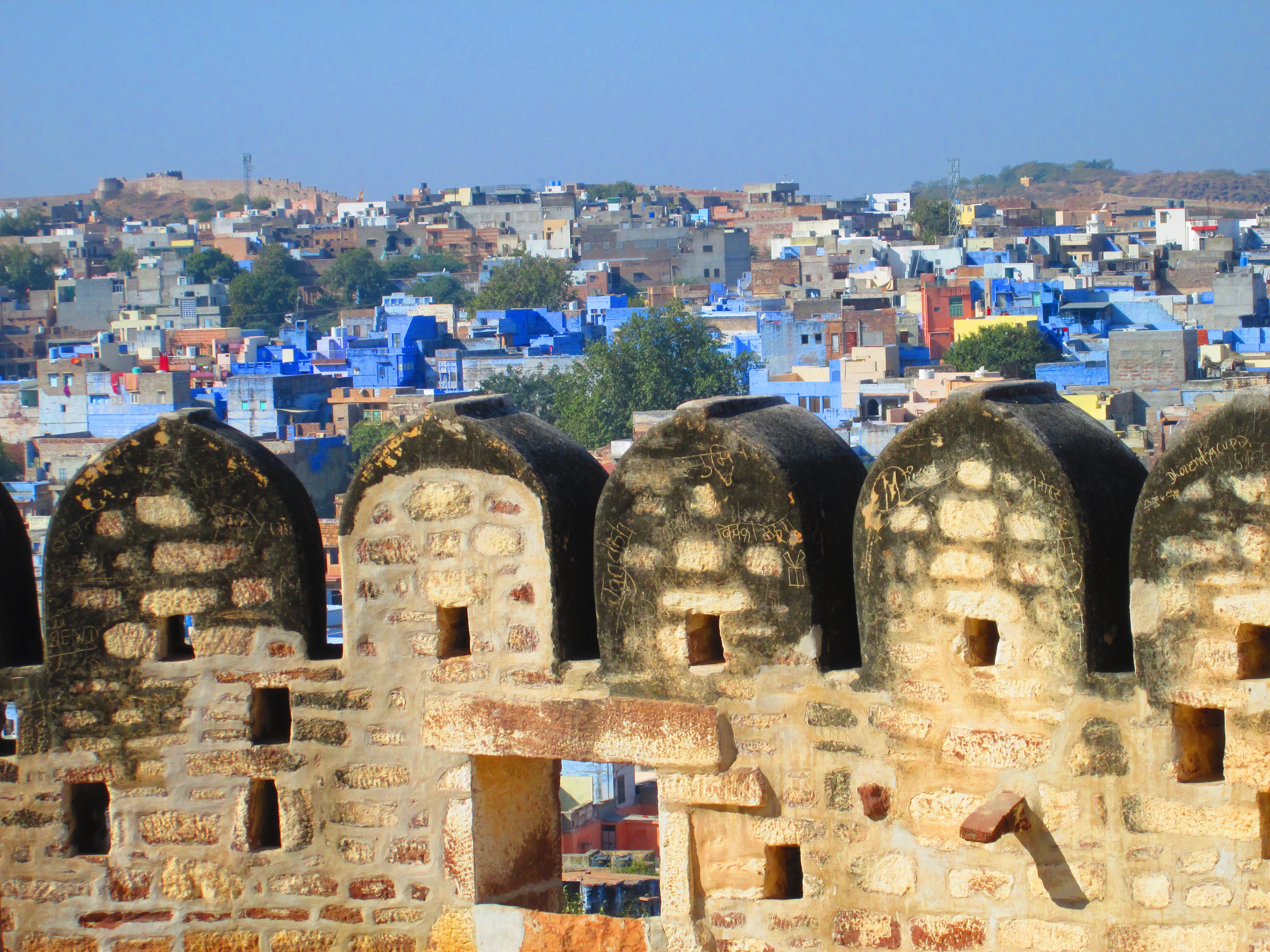
Stockholm: Voulez Vous La Musique

Anyone born in the in the 50s, or the child of parents born in this period are familiar with the band ABBA. To date, they are the most successful pop band to emerge from Sweden, and have been only second in success to the Beatles. Furthermore, they are the only band from a non-English speaking country to ever top the charts of English-speaking countries.   

 I remember fondly the songs I listened to with my mother as a child, popular hits such as the “Dancing Queen,” “Mamma Mia,” and “S.O.S.” would regularly feature on our car rides. Therefore, how could we not take some time to visit the ABBA Museum while we were in Stockholm?

 The museum documents how Agnetha, Björn, Benni, and Anni-Frid found their musical starts. It then demonstrates their creative process and the transpiring events that served as their inspiration. Memorabilia, outfits, and props are proudly on display while imaginative use of technology allows you to do anything from record a vocal track, dance in a music video, or take the stage as their fifth member alongside their holograms. 
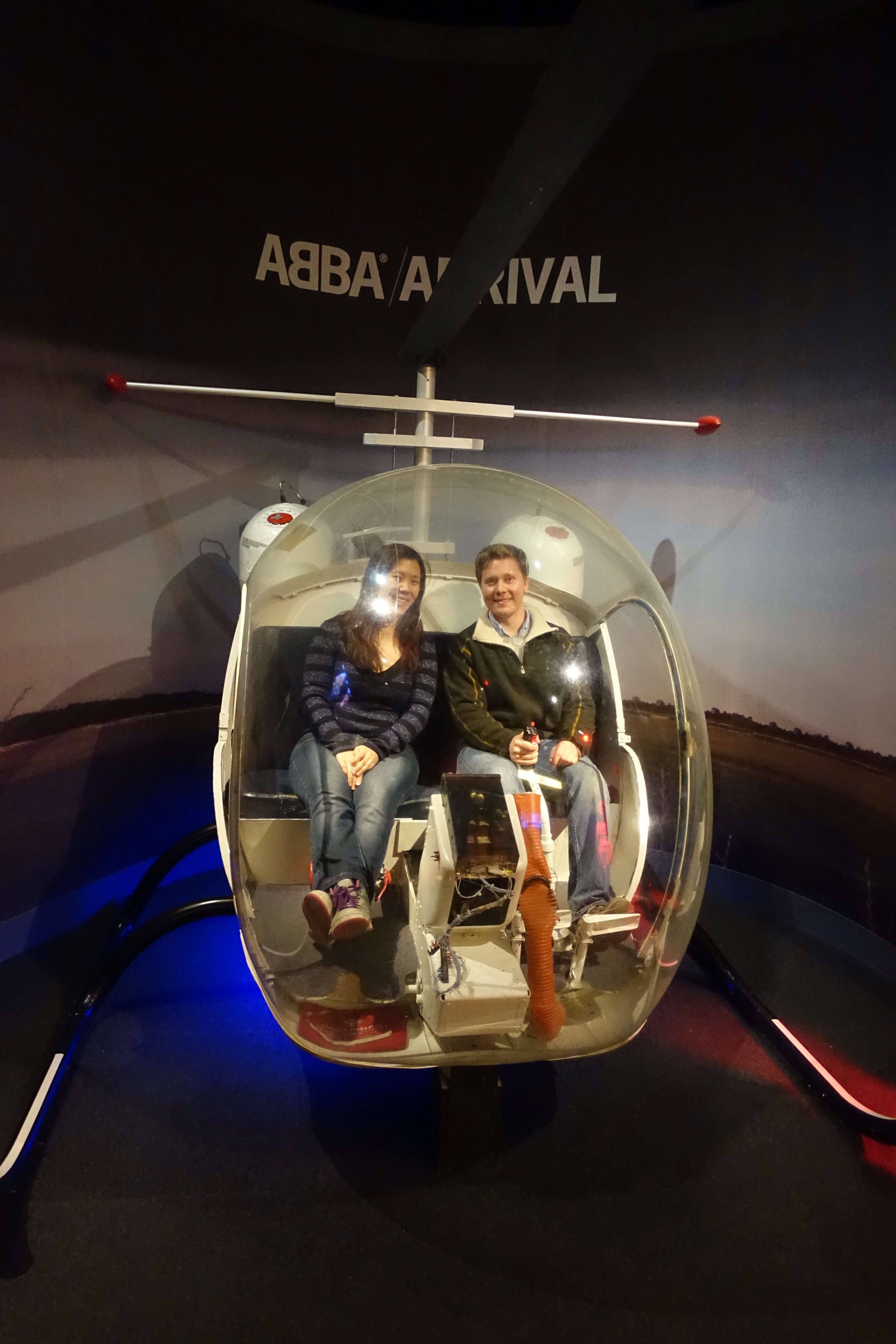
 Tom and I tried the first two with mixed results. It turns out (although I’ve always known this), that I am beyond tone-deaf. Once I bowed out of trying to sing Dancing Queen, Tom’s solo vocals gained a much better score. It was abundantly clear that my inability to carry a pitch was bringing the team down. :(. We also tried to dance in a music-video but couldn’t manage to stop laughing. The hologrammed stage would have been interesting, but there was a line, and the performance would have been public to any passerbys. Stage-fright, a lack of dance moves, and not being a fan-girl were sufficient enough reason to hold back.
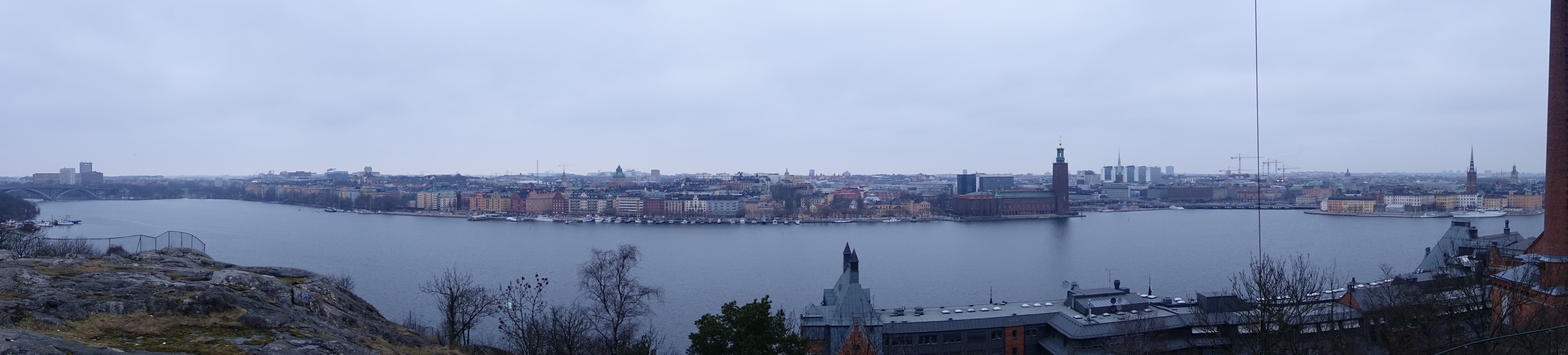
  
We then headed to the highest point in Stockholm to enjoy a breather and take in a scenic view of the city before heading back to the hostel for a break.

 After a brief repose, we grabbed dinner at an Irish Pub nearby before heading on an adventurous walking tour of our own. There are some well-documented odd, secret, and hidden items to be found around Gamla Stan, so Tom and I went on a hunt calling it our own Ghost Walk (quite a few of them were particularly morbid). We visited Hell, commemorated the Stockholm Bloodbath, and admired a Bartizan.

 One of my favorite stops was the statue, “Boy Looking at the Moon.” Arguably the smallest public sculpture in Sweden, it was sculpted by Liss Eriksson in 1954 and retells the memory of his childhood when he would sit on his bed and stare at the moon through his window on sleepless nights. It is made of sandstone and wrought iron. Superstition says that he will bring good luck to anyone that rubs his head. He was wearing a cute knit hat and scarf when we visited him, a gift that Stockholmers like to provide him with during the winter, so we merely patted him on his head. 

Stockholm: Gamla Stan

Our hostel of choice is located in Gamla Stan, the old town. This part of Stockholm is located on one of the small islands of the city’s earliest settlements, and it still maintains its medieval character. 

 After grabbing our customary coffee and snack, we took stroll down the waterfront to catch sight of the Riddarholmen Church. This church is the final resting place of all of Sweden’s monarchs. Parts of the church date from the late 13th century when it was first built as a greyfriars monastery. The building is only open to visit during the autumn and summer, so Tom and I were unable to get inside.

 
Our next stop was the Stockholm Cathedral, the oldest church in Gamla Stan. The facade is in the Swedish Brick Gothic style, but my favorite part was the wooden statue of Saint George and the Dragon. (If a sculpture or statue of this particular biblical event is housed in a house of worship, it is commonly what I admire the most). Attributed to Bernt Notk (1489), the statue was commissioned to commemorate the Battle of Brunkerg (1471), and serves as a reliquary containing the saintly remained of George himself in addition to six others.

 Adjacent to this lies the Stockholm Palace, the official residence of the Swedish Monarch. Nicodemus Tessin the Younger formed its shape like that of a Roman Palace. When he passed away in 1728, the chief architect role passed on to Carl Hårleman who is largely responsible for the the Rococo interior. Construction had started in 1697, but did not officially complete until 1760. This is because work on the building was paused for 18 years due to the expense of the Great Northern War. 

 We then took a leisurely stroll through the Skansen Museum, the first ever open air museum, founded in 1891. One can experience over five centuries of  Swedish history in a visit, and there were several animals romping about in their habitats. The only disappointing part was that the aquarium required an additional fee to visit, and despite my desire to have a close-encounter with lemurs, neither of us could justify paying an additional $12 for it. After all, the USA has some of the best zoos in the world. 

Alta: At First Sight

 The trade-off we made to stay in Alta, which is a bit off the beaten path, was having fewer day activities unless one wants to shell out $$$ to go dog-sledding or snowmobiling. I personally would have liked to visit the Sorrisniva Hotel, a hotel that is carved entirely out of 250 tons of ice every year, but at an entrance fee of $24, the price was too steep for either Tom or I to justify.

We intended to have our time in Alta be a bit lazy hazy, so we slept in and savored some extra sleep. As a result, we didn’t roll into town until the early afternoon. We popped-in to check out the inside of the Northern Lights Cathedral before grabbing some coffee and free wi-fi at a nearby pub.

The current design of the church is the result of a competition in 2001 that was won by a collaboration between schmidt hammer lassen architects and Link Arkitektur. The city council wanted an icon that would highlight Alta’s role as a gateway to the Northern Lights. In the words of founding partner John. F. Lassen, “The Cathedral of the Northern Lights is in its design a result of the surrounding nature and local culture. The building is a landmark, which through its architecture symbolizes the extraordinary natural phenomenon of the Arctic northern lights,…The cathedral reflects, both literally and metaphorically, the northern lights: ethereal, transient, poetic and beautiful. It appears as a solitary sculpture in interaction with the spectacular nature.”

 The sun sets earlier in the North than it did in Oslo, so we were greeted by darkness when we exited the pub. Outside, waiting for us was a varied display of ice sculptures. Some depicted human forms while others were animal sculptures. My favorite, however, was a realistic human heart that had a beating red light inside it. The heart was enclosed by icy brick walls, and I interpreted it as a metaphor for the warmth and life that lies in each of us despite whatever cold, outer, exterior persona we may present to the world. Tom thought I was overthinking it, but I personally like trying to analyze the message an artist is trying to convey.

 We then hopped into the car for Day 2 of our hunt. This time we drove about 2-hours west. The forecast was looking good for clear skies, and based on the lessons from yesterday, we knew we had to look for the stars. After all, if you can see the stars clearly, then you know that clouds are not obstructing the view. Eventually, I started seeing a light green shadow to our back right. At this point, I wasn’t sure whether I was hallucinating it due to my deep desire to see the Northern Lights, but Tom pulled over to have a look and verify my suspicion. It turned out I was right!

 Not too long after, bands of green danced across the sky. Tom and I were so excited about our discovery that we couldn’t help but laugh, and hug, and smile. It was a glorious gift that the universe had presented us, the gift of light. After you truly see the lights with the naked eye for the first time, you know exactly what to look for. It is true what they say, that the lights dance. You can see the shape and the density of the bands and swirls change as the particles shift with the wind. I was so happy to be able to share the experience with someone that is so special to me. 

P.S. I didn’t exactly have the right photography equipment for this shot, so we faked the lighting we’d need by using the car’s headlights.  

Oslo: Ashes of Vikings

The one thing Tom and I do every morning is to take some time to savor a good cup of coffee. We are both aficionados of this savory drink, and it’s a great way to to warm us up from the inside out before we venture off to galavant about a city blanketed in snow. 

Since our legs and feet were so tired from walking about 10 miles yesterday, we decided today would be a museum day. Specifically, we would pass our time by visiting the museums on the Bygdøy Peninsula, an area that still maintains its rural vibe, and houses the Oscharshall Palace, the summer home of the Norwegian Royal Family.

 Our first stop was the Norwegian Folk Museum, an open-air museum that has many traditional buildings on site that allow you to explore the daily lifestyles of Norwegians from the 16th century and onwards. They also had a few exhibit halls that displayed typical wardrobes and furniture from these eras. The primary reason I wanted to visit however, was to see the Gol Stave Church.

 This one is from 1212, meaning that its over 800 years old! Stave churches were medieval Christian churches that developed in Northern Europe. The name for this type of structure is derived from the Old Norse term “stafr,” meaning the type of timber framing where load-bearing ore-pine posts support lintels. It’s a descendent of palisades construction from the Viking Age. Logs were split into two halves, driven into the earth, and a roof erected over it. 

 The Gol Church falls under a smaller sub-category called the Borgund Group. The stability of the structure is further enhanced by cross-bracing that joins the upper and lower beams and posts. This essentially creates a truss which allows for the weight of the building to be transferred into the ground without the need for intermediate posts, creating a wider, more open, interior space. 

Next, we stopped by the Viking Ship Museum, because what visit to Norway would be complete without getting the chance to learn about Viking history? 


Oslo: City of Tigers II

In 1870, Bjørnstjerne Bjørnson wrote a poem titled , “Sidste Sang”. In it, he illustrates a dramatic fight between a horse and a tiger. The tiger, metaphorically represented the dangerous city, while the horse symbolized the security of the countryside. This is where he first referred to Oslo as Tigerstaden, which represented his perception of the city as a cold and dangerous place. 

 This has not been the case for Tom and I. We have found this snowy, northern city to be warm and friendly. Our barista from earlier this morning graciously gave us a list of restaurants to eat at, and even attempted to teach me the word for “thanks” in Norwegian, “Taak”. (I hope I haven’t been butchering the word too much, but I always like to learn how to say “please” and “thank you” when I travel. I’ve found it is a simple way to show your enthusiasm for the local history and, even though they may laugh, the locals often appreciate your effort.) 

 Making use of one of the barista’s recommendations, we ventured towards Aker Brygge, a unique, waterfront development that was completed in 2014. It was formerly the site of a shipyard and industrial buildings. Vingen, a restaurant attached to the Astrup Fearnley Museet was difficult to find, but incredibly tasty! Tom had the Eggs Benedict, while I had their version of a Katz Pastrami Sandwich.

 After a brief break, we ventured back into the cold to explore the history of the Akershus Fortress. Construction of the fortress is believed to have started around 1290 when King Hakon V realized that the city needed a stronger defense center than that which currently existed. Since it lied adjacent to the sea, it allowed Norway to prosper commercially while providing the nation with a strong military presence. 

 The Akershus Fortress has never been successfully besieged by a foreign enemy. However, in 1940, it surrendered to Nazi Germany without combat. The Norwegian government evacuated the capital when it was unprovokedly assaulted.

  
Our feet getting wary, we decided to make our last stop for the day before heading back to the hostel to rest our laurels. The Oslo Opera House is uniquely designed such that the roof of the structure angles to the ground level. This creates an elevated plaza that allows pedestrian interaction with the building. Tom and I climbed all the way up and were greeted with a panoramic view of the waterfront.

As a structural engineer,the fact that this roof is merely supported by thin angled columns is intriguing. How, exactly did they analyze the load paths/patterns through the asymmetrical characteristics of the column geometry?  The minimalistic framing and specialty glass allows for optimal views of the surrounding water. 

 From the roof, and at ground level, we observed the sculpture, “She Lies.” The stainless steel and glass fabrication resembles ice and depicts a symbol of power for the region. As it lays on a transient concrete platform, it is free to turn with the bidding of the tide and the wind. I think the sculpture is a metaphor. For as quick as the tides change and the wind changes direction, so too can the power shift.  

P.S. Tom is currently passed out next to me. If anything, my boyfriend could certainly hibernate through a long winter if instinct required it of him. 😛

Travel: Elephants

imageElephants are creatures that are revered in India. According to Hindu Cosmology, the earth is supported and guarded by mythical World Elephants at the compass points of the cardinal directions. Sanskrit literature even attributes earthquakes to the shaking of their bodies when the elephants tire of their burden.

The deity Ganesh(a) is the god of wisdom, and he is distinctively represented by a human form with the head of an elephant, which was placed after the human head was either decapitated or burned from the body.

imageHowever, this is not how the Elephanta Caves, with origins dating between the 5th and 8th centuries, received their namesake. In the 16th century, the Portuguese named the island “Elephanta Island” in honor of a huge, monolithically rock-cut black stone of an elephant on a mound; this unfortunately has been relocated to the Mumbai Zoo.

Credit: Nikhil Kulkarni

Credit: Nikhil Kulkarni

 Despite being just 7 miles east of the port, the ferry ride took an hour to get there! Fortunately, I caught some great views of the Gateway of India, the exit causeway through which the last British troops passed through on February 28, 1948, signalling an end to British rule and the beginning of Indian independence.

In each of the caves, Shiva or Mahadeva, “Great God” is aniconically represented by a Lingam, a single rock rounded at the top. Aniconism is the avoidance of using images to represent divine beings, prophets, and religious figures.

However, I happen to find the monolithic rock to be an appropriate manifestation of Shiva.

image 

At his highest level, Shiva is considered limitless and transcendent, unchanging and formless. Why not abstractly represent him as something from nature that also adheres to these characteristics? Are rocks not powerful? Do they not withstand the test of the time?

I may not be Hindu, but even I was moved. I couldn’t help but place my palm against the rock and close my eyes, taking some time to summon my faith, and chant the Buddhist Mantra I learned as a child beneath my father’s wing.

Travel: Ranakpur Apathy

image

Our initial plan today was to hire a taxi to day trip to Ranakpur before being dropped back at the airport for our flight to Mumbai later tonight. Unfortunately, our lack of internet connection at the hostel proved to be our downfall.


While I had posited asking the staff for advice on taking buses, Nick didn’t hear me, and I was too snuggled into my cozy cocoon to emerge from the warmth. We did not make it to Ranakpur and I regret not summoning the willpower to face the cold. Admittedly though, it was really nice to have an open day with nothing planned.

Credit: Ingo Mehling

Credit: Ingo Mehling

Ranakpur is 91 km away from Udaipur, making it approximately a 1-hour car ride in US terms and a 2.5 to 3-hour travel time according to IST (one needs to factor in traffic, rough roads, and slower speed limits). It is home to a  UNESCO World Heritage Site, a massive, sprawling, Jain Temple constructed entirely of marble in 1437.

imageIt is with sorrow that I cannot speakbout how amazing the structure was, as it has over 1444 pillars that are each uniquely carved in exquisite detail. Additionally, there is a massive rock that is carved into 108 snake heads and tails. The layout of the building is in the form of a chaumukha – four faces in each of the four cardinal directions that symbolize the cosmos.

Instead, Nick went off to meet his Uncle and I found a little cafe to savor coffee in while using their wifi for some net-based tasks. We met up again later that morning to visit Monsoon Palace.

image

Credit: Nikhil Kulkarmi

The Monsoon Palace was built in 1884 entirely of white marble on the Bansdara Peak of the Aravalli Hill. At a total elevation of 3100 ft overlooking Lake Pichola, the original intent was for it to be a 9-story astronomical centre to track the movement of the monsoon clouds. It would also be a vacation home for the royal family.


imageUnfortunately, despite the innovative water harvesting system the building utilized in its underground cistern, the storage capacity proved to be inadequate resulting in the abandonment of the palace.

After the palace, all we had to do was get Nick a shave for the wedding, and find him some shoes. This was surprisingly almost as difficult as finding me a Saree; there’s not much you can do about a gigantor’s foot size when you are on a continent that tends to produce petite-sized humans.


Travel: Venice of the East

imageNick and I actually delayed our travels to the city of Udaipur by a day because we wanted to visit the Fort. Hence, rather than a 7:30 AM bus, we caught a 6.5-hr sleeper bus. Since it was a non-AC bus, we were feeling pretty optimistic that it would not be too cold. After all, how often does a typical commercial bus have openly ventilated windows? Much to our dismay, even though each cot had its own glass-enclosed cubicle, the windows to open air were not tightly sealed, and therefore it was impossible to limit the amount of penetrating cold desert air.

imageEven worse, I woke up at 3 AM with a pressing need to use the toilet, with no possibilities in sight. I was concerned that even if I asked the driver to pull to the side, the language barrier would prevent him from fully understanding that I needed him to wait for me. I was terrified that he’d drive off and leave me, in the desert, by myself, in the middle of the night. A long struggle later, Nick finally woke up, and he made sure the bus driver didn’t leave me behind (though he was concerned when he felt the wheels of the bus inching). 😦  There is never anything glamorous about popping a squat in a dark ally out of sheer necessity.

Credit: Nikhil Kulkarni

Credit: Nikhil Kulkarni

When we finally arrived at our hostel around 6 AM, they had given our beds away (even though we had called the previous day to give them fair warning)! Nick and I ended up having to squeeze ourselves into two very small chairs with a blanket to catch a little more shut-eye.


Needless to say, we did not feel very rested when we finally awoke, and had a pretty lazy day.

Credit: Nikhil Kulkarni

Credit: Nikhil Kulkarni

Udaipur, often called the “Venice of the East” for the its beautiful lakes, was founded in 1559 by Maharana Udai Singh II as the last capital of the Mewar Kingdom. It was during this time that the City Palace first came into existence. In reality, the City Palace is not merely one palace, rather it is a sprawling complex consisting of many different palaces that were constructed by 76 different kings over the course of nearly 400 years.

image

Credit: Nikhil Kulkarni


The royal family, the Sisodia Rajputs “Worshipers of the Sun God,” built each palace to face east, in order to greet the rising sun. The exquisite facade of the 11 palaces spans a total length of 800 ft, and a total height of 100 ft. A unique trait of the architecture is that, since the total structure was built over an extended period of time, one can see a diverse blend of different styles. Each characteristic of the Rajasthani, Mughal, Medieval, European, and even Chinese Architecture is paradoxically homogenous and unique at the same time.


It is said that the Maharana (distinct from the term Maharaja) built his palace atop the hill following the advice of a hermit who he had found meditating at the summit.

Merry Christmas from Jodhpur!

imageWe all woke up late this morning due to the festivities of last night. The staff had cleaned up the cake (from the glitter firecrackers) and shared some slices with us. Nick didn’t pull his string aggressively enough, so he decided to pour all of his glitter over my head. -_- I may still be sparkling….
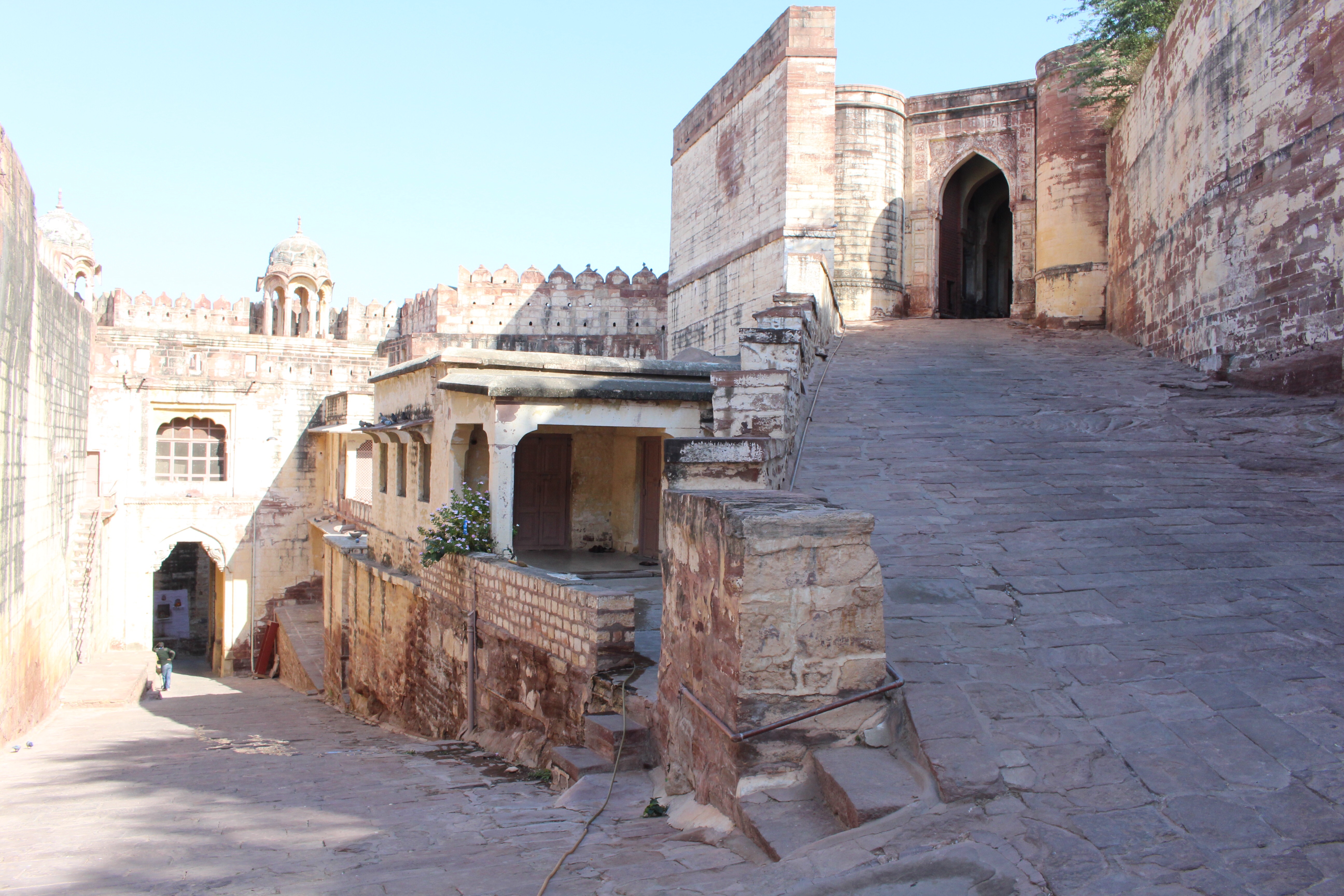
Craig, one of the new friends we made last night, was traveling alone so we invited him to explore the city with us. We trekked up the hill at the center of the Jodhpur old city and entered one of the seven gates of Mehrangarh Fort.

image


The fort is situated 400 ft above the city and surrounded by thick walls. Within the complex are several palaces known for the intricacy of their carvings and the botanical diversity of their courtyards.

image


Legend says that Bhaurcheeria, “The Mountain of Birds,” initially had a single human occupant. In order to build Jodha’s fort, Cheeria Nathji, “Lord of the Birds,” was forced to leave. In his anger, the hermit cursed Jodha:

“Jodha! May your citadel ever suffer a scarcity of water!”

image

Credit: Nikhil Kulkarni


Nathji was only marginally appeased by the construction of a house and temple within the fort that was in close proximity to the cave that the hermit had meditated in. However, even to this day,the area is plagued by a drought every 3 to 4 years.

image


As an even more extreme measure to ensure his new site was propitious, Jodha buried a man named “Raja Ram Meghwal” alive beneath the foundation. In return, Meghwal’s family was guaranteed to be looked after by the Rathores. Even to this day, his descendants still live in Raj Bagh, an estate beaquethed to them by Jodha.

imageAfter catching a gorgeous view of the “Blue City” from high above, we started our descent on the other side of the hill, and came across some traditionally dressed girls with baskets on their heads. I find it quite fascinating that even in this modern-day and age, a diverse array of traditional clothing can be seen in India as a stark contrast to the more readily adopted Western Clothing.

imageWe then paused by the Jaswant Thada for a breather, before continuing to engage in some aimless traipsing through the streets.

Link

Travel: Generous Jodhpur

imageShukriya is the first word that I learned in Hindi. It means “Thank You.” This is always the first term I learn when traveling in a foreign country because it allows me to thank all the kind people who help me find my way when I am lost and confused.


For me, it tells the locals, ‘Thank you for sharing your culture and heritage with me, Thank you for your generosity, and Thank you for welcoming me.’

image


Today, is Christmas Eve, and it seems like an appropriate day to be grateful for the luxury of traveling. Too few people are given the opportunity, or have a passion to explore the world as I do. Let’s be honest, the hobby of adventure requires both capital and time, and such a large portion of the human population enjoy neither.


imageA family who can afford this extravagance is the Jodhpur Royal Family, and we visited their private residence, the Umaid Bhawan Palace. Built in 1943, the construction of the palace provided employment to thousands of citizens during a famine. Numbering at a total of 347 rooms, the building serves three purposes. It functions as a home, a hotel, and a museum.

imageLeaving the opulence of the structure behind, we headed back to the Saree store from yesterday for a final fitting. The fit was off, and the design of the blouse was not what we had discussed. Nick and I were both extremely frustrated as we had spent about 2-3 hours at the store yesterday to discuss and hash out all the details to make sure we got what we wanted.

We ended up walking out of the store unhappy and disgruntled.  Fortunately, my deposit was negotiated down to 500 rupees, so I only lost about $7 on this Saree attempt.

imageWe ended up making a third attempt at buying a Saree at the Sadar Bazaar, and settled on a dark blue Saree of a different style. I already decided that I refuse to buy more shoes or bangles to match this new color, so some clashing may occur. Thankfully, I know that no matter what I wear, I will still stand out of the crowd at the Wedding.

imageAfter dropping off our purchases at the hotel, we started to hike up to the fort before realizing it was closed for the day. On our way back down the streets, Nick started conversing with a young man, around our age, who promptly invited us into his home, which had been in his family for over 100 years. His mother and father were super inviting, and presented us with chai. Granted, much of the conversation was lost on me, but the mother asked to take a photo with me because she thought I was so beautiful. 😀

imageWe bid adieu with the intent to return to our hotel. A group of kids in an alley stopped us and asked for American coins, I felt bad because I didn’t have anything to offer. Their family also proceeded to welcome us with open arms, and we spent some time talking with the kids and their parents while savoring our second cup of Chai. They played a few games on my cell phone, and when the girls wanted to paint my nails, I couldn’t say no. Their future dreams ranged from working in Law Enforcement to being a Doctor. It was incredibly heartwarming to hear about their ambition, and Nick and I encouraged them all to study hard as we left.

Our hotel, the Castle View HomeStay threw all of its lodgers a party for Christmas Eve. We lit a lantern and attempted to let it float up into the sky, but alas, the windy conditions were not in our favor, and the lantern dropped like a rock. It was really funny at the time, and incredibly endearing how much effort the staff had put in. A ‘Santa Claus’ was nominated who gave us small handicraft gifts that are local to the region, and we enjoyed a buffet dinner together with some Gulab Jamun, a sweet milk dessert from a famous bakery in the city.

Previous Older Entries Next Newer Entries