26 Dec 2014
by PhoenixKaio
in Architecture, Art, History, India, Myths & Legends, Politics, Travel
Tags: Architectural Blends, City Palace, Desert, First World Problems, Fort, Hermit, Lakes, Maharana, Sleeper, Toilets, Udaipur, Venice
 Nick and I actually delayed our travels to the city of Udaipur by a day because we wanted to visit the Fort. Hence, rather than a 7:30 AM bus, we caught a 6.5-hr sleeper bus. Since it was a non-AC bus, we were feeling pretty optimistic that it would not be too cold. After all, how often does a typical commercial bus have openly ventilated windows? Much to our dismay, even though each cot had its own glass-enclosed cubicle, the windows to open air were not tightly sealed, and therefore it was impossible to limit the amount of penetrating cold desert air.
 Even worse, I woke up at 3 AM with a pressing need to use the toilet, with no possibilities in sight. I was concerned that even if I asked the driver to pull to the side, the language barrier would prevent him from fully understanding that I needed him to wait for me. I was terrified that he’d drive off and leave me, in the desert, by myself, in the middle of the night. A long struggle later, Nick finally woke up, and he made sure the bus driver didn’t leave me behind (though he was concerned when he felt the wheels of the bus inching). 😦 There is never anything glamorous about popping a squat in a dark ally out of sheer necessity.

Credit: Nikhil Kulkarni
When we finally arrived at our hostel around 6 AM, they had given our beds away (even though we had called the previous day to give them fair warning)! Nick and I ended up having to squeeze ourselves into two very small chairs with a blanket to catch a little more shut-eye.
Needless to say, we did not feel very rested when we finally awoke, and had a pretty lazy day.

Credit: Nikhil Kulkarni
Udaipur, often called the “Venice of the East” for the its beautiful lakes, was founded in 1559 by Maharana Udai Singh II as the last capital of the Mewar Kingdom. It was during this time that the City Palace first came into existence. In reality, the City Palace is not merely one palace, rather it is a sprawling complex consisting of many different palaces that were constructed by 76 different kings over the course of nearly 400 years.

Credit: Nikhil Kulkarni
The royal family, the Sisodia Rajputs “Worshipers of the Sun God,” built each palace to face east, in order to greet the rising sun. The exquisite facade of the 11 palaces spans a total length of 800 ft, and a total height of 100 ft. A unique trait of the architecture is that, since the total structure was built over an extended period of time, one can see a diverse blend of different styles. Each characteristic of the Rajasthani, Mughal, Medieval, European, and even Chinese Architecture is paradoxically homogenous and unique at the same time.
It is said that the Maharana (distinct from the term Maharaja) built his palace atop the hill following the advice of a hermit who he had found meditating at the summit.
25 Dec 2014
Merry Christmas from Jodhpur!
 We all woke up late this morning due to the festivities of last night. The staff had cleaned up the cake (from the glitter firecrackers) and shared some slices with us. Nick didn’t pull his string aggressively enough, so he decided to pour all of his glitter over my head. -_- I may still be sparkling….
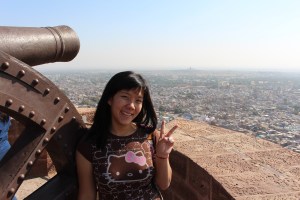
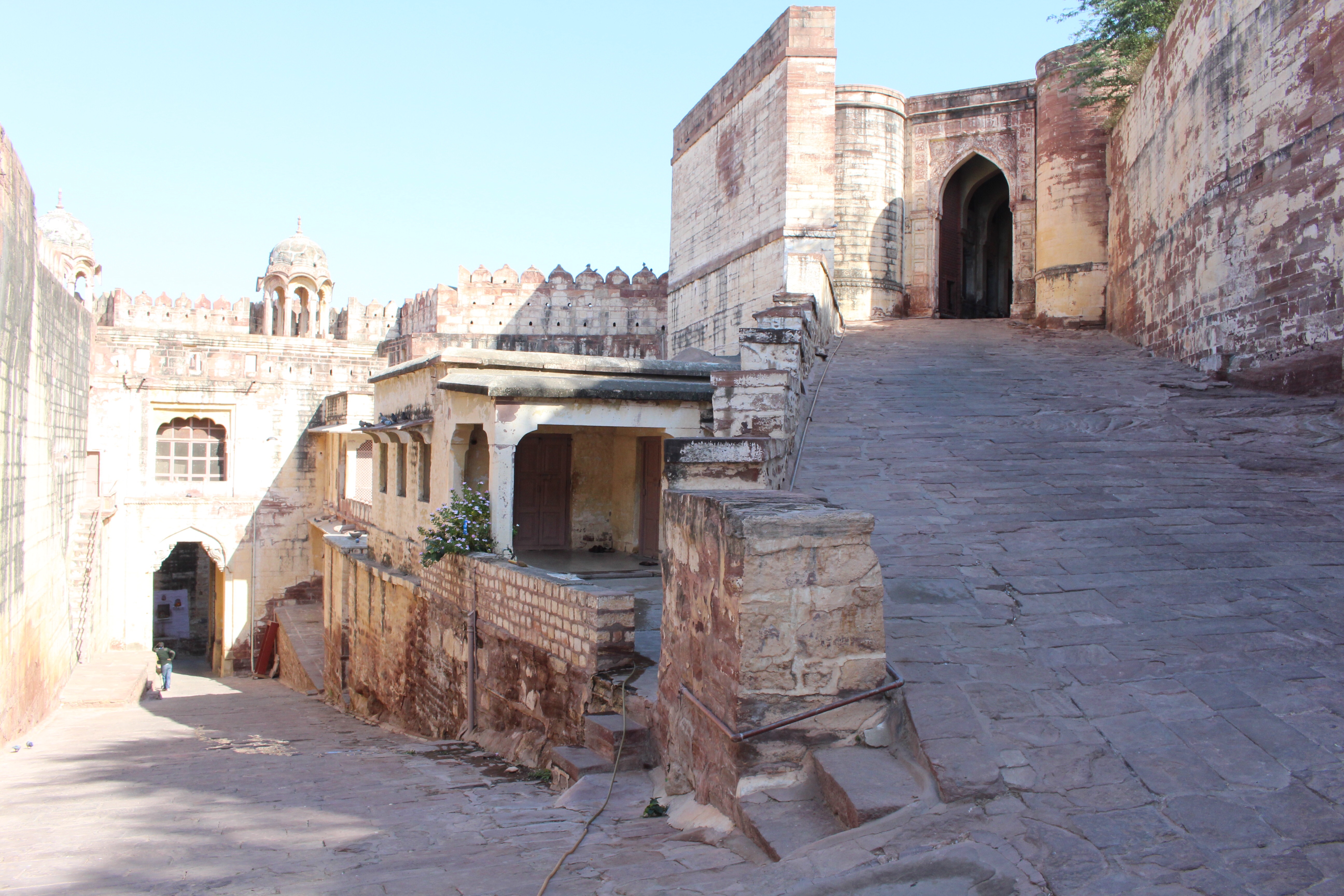
Craig, one of the new friends we made last night, was traveling alone so we invited him to explore the city with us. We trekked up the hill at the center of the Jodhpur old city and entered one of the seven gates of Mehrangarh Fort.

The fort is situated 400 ft above the city and surrounded by thick walls. Within the complex are several palaces known for the intricacy of their carvings and the botanical diversity of their courtyards.

Legend says that Bhaurcheeria, “The Mountain of Birds,” initially had a single human occupant. In order to build Jodha’s fort, Cheeria Nathji, “Lord of the Birds,” was forced to leave. In his anger, the hermit cursed Jodha:
“Jodha! May your citadel ever suffer a scarcity of water!”
Credit: Nikhil Kulkarni
Nathji was only marginally appeased by the construction of a house and temple within the fort that was in close proximity to the cave that the hermit had meditated in. However, even to this day,the area is plagued by a drought every 3 to 4 years.

As an even more extreme measure to ensure his new site was propitious, Jodha buried a man named “Raja Ram Meghwal” alive beneath the foundation. In return, Meghwal’s family was guaranteed to be looked after by the Rathores. Even to this day, his descendants still live in Raj Bagh, an estate beaquethed to them by Jodha.
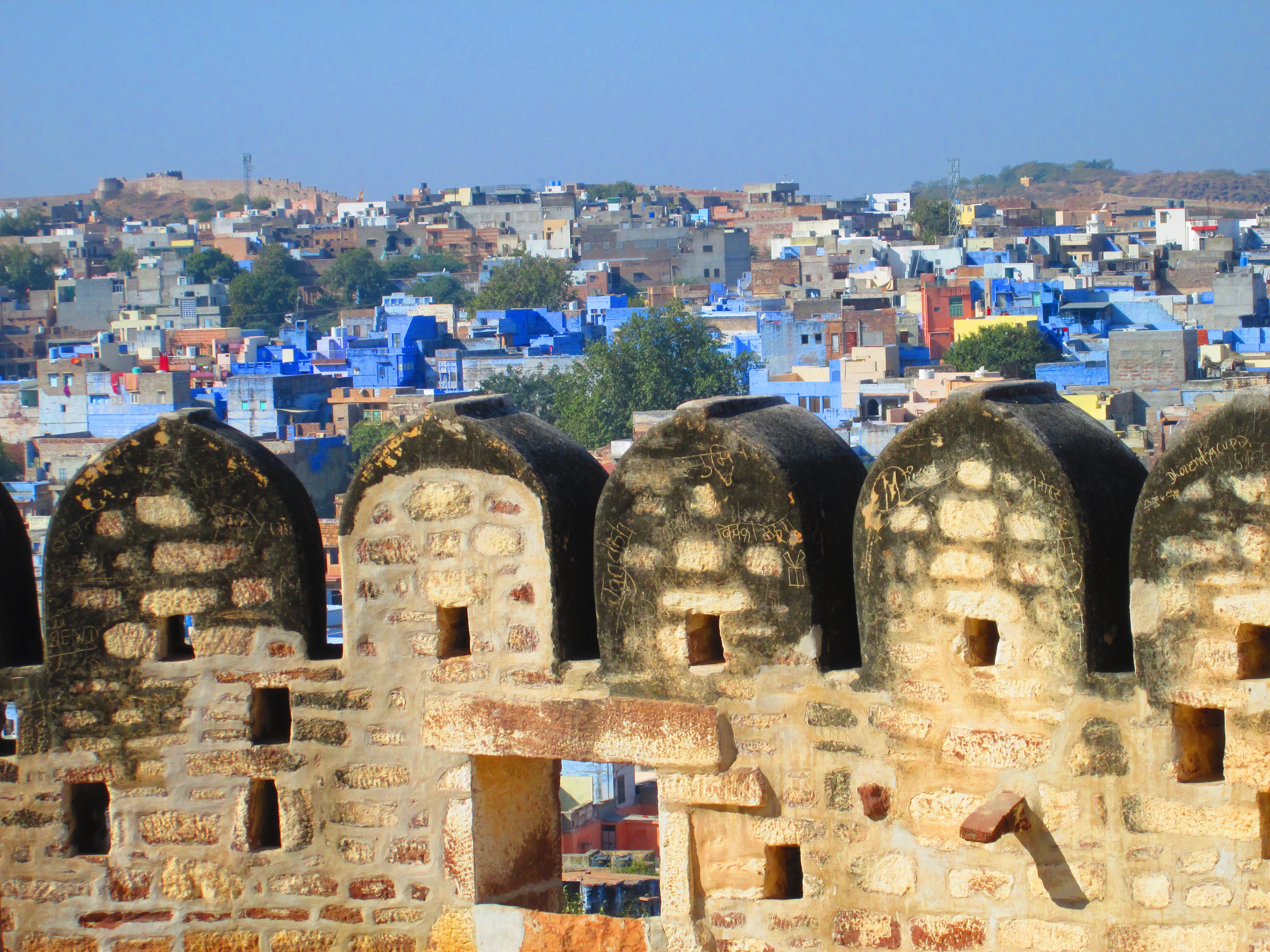
 After catching a gorgeous view of the “Blue City” from high above, we started our descent on the other side of the hill, and came across some traditionally dressed girls with baskets on their heads. I find it quite fascinating that even in this modern-day and age, a diverse array of traditional clothing can be seen in India as a stark contrast to the more readily adopted Western Clothing.
 We then paused by the Jaswant Thada for a breather, before continuing to engage in some aimless traipsing through the streets.
Link
by PhoenixKaio
24 Dec 2014
by PhoenixKaio
in Architecture, Family, India, Love, Natural Beauty, Travel
Tags: Christmas Eve, Friendly, Generosity, Hindi, Jodhpur, Luxury, Masala Chai, Opulence, Royalty, Saree, Thankful, Thankfulness, Umaid Bhawan Palace, Welcoming
 Shukriya is the first word that I learned in Hindi. It means “Thank You.” This is always the first term I learn when traveling in a foreign country because it allows me to thank all the kind people who help me find my way when I am lost and confused.
For me, it tells the locals, ‘Thank you for sharing your culture and heritage with me, Thank you for your generosity, and Thank you for welcoming me.’

Today, is Christmas Eve, and it seems like an appropriate day to be grateful for the luxury of traveling. Too few people are given the opportunity, or have a passion to explore the world as I do. Let’s be honest, the hobby of adventure requires both capital and time, and such a large portion of the human population enjoy neither.
 A family who can afford this extravagance is the Jodhpur Royal Family, and we visited their private residence, the Umaid Bhawan Palace. Built in 1943, the construction of the palace provided employment to thousands of citizens during a famine. Numbering at a total of 347 rooms, the building serves three purposes. It functions as a home, a hotel, and a museum.
 Leaving the opulence of the structure behind, we headed back to the Saree store from yesterday for a final fitting. The fit was off, and the design of the blouse was not what we had discussed. Nick and I were both extremely frustrated as we had spent about 2-3 hours at the store yesterday to discuss and hash out all the details to make sure we got what we wanted.
We ended up walking out of the store unhappy and disgruntled. Fortunately, my deposit was negotiated down to 500 rupees, so I only lost about $7 on this Saree attempt.
 We ended up making a third attempt at buying a Saree at the Sadar Bazaar, and settled on a dark blue Saree of a different style. I already decided that I refuse to buy more shoes or bangles to match this new color, so some clashing may occur. Thankfully, I know that no matter what I wear, I will still stand out of the crowd at the Wedding.
 After dropping off our purchases at the hotel, we started to hike up to the fort before realizing it was closed for the day. On our way back down the streets, Nick started conversing with a young man, around our age, who promptly invited us into his home, which had been in his family for over 100 years. His mother and father were super inviting, and presented us with chai. Granted, much of the conversation was lost on me, but the mother asked to take a photo with me because she thought I was so beautiful. 😀
 We bid adieu with the intent to return to our hotel. A group of kids in an alley stopped us and asked for American coins, I felt bad because I didn’t have anything to offer. Their family also proceeded to welcome us with open arms, and we spent some time talking with the kids and their parents while savoring our second cup of Chai. They played a few games on my cell phone, and when the girls wanted to paint my nails, I couldn’t say no. Their future dreams ranged from working in Law Enforcement to being a Doctor. It was incredibly heartwarming to hear about their ambition, and Nick and I encouraged them all to study hard as we left.
Our hotel, the Castle View HomeStay threw all of its lodgers a party for Christmas Eve. We lit a lantern and attempted to let it float up into the sky, but alas, the windy conditions were not in our favor, and the lantern dropped like a rock. It was really funny at the time, and incredibly endearing how much effort the staff had put in. A ‘Santa Claus’ was nominated who gave us small handicraft gifts that are local to the region, and we enjoyed a buffet dinner together with some Gulab Jamun, a sweet milk dessert from a famous bakery in the city.
23 Dec 2014
by PhoenixKaio
in Architecture, India, Landscape, Natural Beauty, Travel, Urban Design
Tags: Bargaining, Bazaar, Clock Tower, Colorful, Custom, Jodhpur, King, Marwar Kingdom, night train, Saree, Sleeper Trains, Thumbs Up, Unprepared
After Ranthambore, Nick and I had booked a night train to our next city, Jodhpur.
 As has often been the case, we were woefully unprepared for how basic the sleeper cabins were. Unlike trains in Europe, you are only provided a cot. It was only after we found our berths that it dawned on us why so many people on our platform had brought pillows and blankets.
Needless to say, it was the coldest night we’ve had. The train windows are openly ventilated, and despite putting on all our layers, time passed slowly. I’m pretty sure I contracted a cold because of this. 😦

Jodhpur is known by two names, the “Sun City” for the year-round sunny weather, and the “Blue City” due to the uniquely blue houses that surround the fort. It is the second largest city in Rajasthan, and was formerly the capital of the Marwar Kingdom.
 Nick and I were not up for much after we finally arrived at our hotel. It was also the King’s Birthday (royalty still resides in the palace) so all of the major tourist attractions happened to be shut down. We opted to visit the Ghanta Ghar “Clock Tower,” and roam the nearby Sadar Bazaar to make a second attempt at finding me a Saree.

It took quite a bit of negotiating, but we finally found a shop that had all the pieces and would measure me so that it would be a custom-fit. We then proceeded to buy all the requisite shoes and jewelry to match this outfit before heading back to the hotel for dinner and an early night.
22 Dec 2014
by PhoenixKaio
in Animals, India, Landscape, Natural Beauty, Travel
Tags: Appearances, Bengal Tigers, Black Market, Endangered Species, India, national park, nature, Northern India, Poaching, Ranthambore National Park, Wildlife
 We decided to take a walk on the wild side today and ventured southeast of Jaipur to visit Ranthambore National Park.
It is about 160 km away from the city, which realistically should only be a 2.5-hr drive, however it ended up being around a 4-hr drive given the poor state of the roads outside the larger cities, the slower pace due to a sandstorm, and the traffic that is classically India.
After arriving at the park entrance, it took Nick some serious negotiating and the help of the local policeman to secure spots on a safari vehicle for us. The individual that had guaranteed us seats earlier in the day was unable to deliver; fortunately, he refunded all of our money.

Credit: Himangini Rathore Hooja
Ranthambore is one of the largest national parks in Northern India, covering a total area of 392 sq. km. Declared one of the Project Tiger Reserves in 1973, it became a national park in 1980. The sanctuary is best known for its tigers, and it is for this reason that we visited, with hopes to see one in its natural Jungle Habitat.
Unfortunately, this did not happen, despite the tiger population being at 61 – the highest its been in the last decade.
It is important to recall that the species native to India, the Bengal Tiger, is classified as endangered, with less than 2,500 existing worldwide, and a downward trend. As with most creatures on the endangered species list, poachers are a constant threat to their existence.
 The sad truth is that the rarer the animal is, the higher is the asking price for their meat, skins, and bones on the black market. Too many individuals are concerned with appearances and are constantly finding ways to display their power and wealth.
We did, however manage to see some of the other native wildlife, and even spotted paw prints in the dirt!


21 Dec 2014
by PhoenixKaio
in Architecture, Faith, History, India, Innovation, Landscape, Myths & Legends, Natural Beauty, Religion, Symbolism, Travel
Tags: Camels, Conservative, Dress Up, Elephants, Galta Ji, Jaipur, Jal Mahal, Man Sagar Lake, Monkeys, Mughal, Pilgrimage, Rajput, Red Sandstone, Strange Couples, Temple
This morning, we both enjoyed the luxury of sleeping in before heading for a walk around the Man Sagar Lake to observe the beauty of the Jal Mahal “Water Palace.” We even got to see an elephant just strolling down the street amidst the motorcycles and rigshaws, and a camel just resting its legs!


Interestingly, Maharaja Madho Singh I constructed the complex in 1750 intending for it to be a lodge for himself and his entourage during duck hunting parties, it was never intended to be a palace.
 It is considered a classic example of Rajput and Mughal Architecture, and as we’ve seen often during our trip, composed entirely of red sandstone. There is a rectangular chhartri on the roof, and four octagonal chhattris on each of corners of the building. They are elevated dome-shaped pavilions that have become a signature of Indian Design.
Based on plain observation, one cannot derive the complexity of design and technological forethought involved in this structure. While we only see it as a one-story building, in reality, the palace has five floors in total, four of which are submerged in the lake

As we savored the nice weather and strolled along the lake, we came across a costume peddler and decided to have fun and play “dress-up.” The most awkward part of this, was when they wanted us to pose and take a picture as a couple. [Insert Awkward Turtle].

Credit: Nikhil Kulkarni
India is still a conservative nation, so when they see a man and a woman travel together, assumptions are often made. Additionally, seeing an Indian and an Asian together is almost an unheard of circumstance. Fortunately, Nick and I had a good laugh about this.

We wandered the area and found ourselves a nice open garden to take a seat in and relax, before grabbing lunch and heading to hike up to Galta Ji.
 The pilgrimage site lies in the town of Khania-Balaji, just outside of Jaipur. It is known for its natural water springs that accumulate in tanks “kunds”. Thousands come to bathe in these waters every year as it is considered auspicious. Additionally, some believe that the Saint Galav lived here. He meditated, did penance, and survived for years just drinking cow’s milk.

Credit: Nikhil Kulkarni
Galta Ji is also commonly called “The Monkey Temple” as a tribe of monkey lives there. Nick was being mean and joking that he had reunited me with my family. T.T.
I’ve self-perpetuated this ongoing joke when, a few years ago, I discovered that my strangely shaped thumbs coincidentally align with the thumb shape of a gorilla. It is all in good fun though, and I enjoyed getting up close and personal with my brethren.


Credit: Nikhil Kulkarni
20 Dec 2014
by PhoenixKaio
in Architecture, Art, Faith, Handicraft, India, Myths & Legends, Religion, Symbolism, Travel
Tags: Albert Hall Museum, Arches, Architecture Movement, Carvings, Colorful, Crafts, Domes, Ethnic Clothing, Handiwork, Hinduism, Jaipur, Rajasthan, Saree

Credit: Nikhil Kulkarni
After our lunch break, we decided to cut through the Bazaar on our way to the Albert Hall Museum. I have never seen as much color as I have in Jaipur. Nick says that the handicrafts of Rajasthan are so vibrant to contrast the muted colors of the desert.
In truth, the aristocrats of Jaipur were avid patrons of the arts. They often coaxed skilled artisans from around India and abroad to settle in Jaipur and make it their home. I’ve included a few pictures below to illustrate the broadness of their crafts.


Credit: Nikhil Kulkarni
 The Albert Hall Museum was designed by Sir Samuel Swinton Jacob in 1887, and exemplifies Indo-Saracenic Architecture. This form of architecture originated in the late 19th century as a movement by British Architects to merge elements from native Indo-Islamic and Indian Architecture with the Gothic and Neo-Classic styles of Victorian Britain. Some of the typical characteristics you may see include: Onion Domes, Scalloped Arches, Minarets, and Domed Kiosks. We decided not to meander too long on the exhibits, because Nick isn’t a fan of museums, and I’m still a little museum-dead from my epic Eurotrip.
Our last stop of the day was the Birla Temple. The temple is dedicated to Lord Vishnu, the preserver, and his consort Lakshmi, the Goddess of Wealth.
 Despite being a “modern” structure, – completed in 1988 – symbolism is still rampantly prevalent in the architecture of the building. Each of the three huge domes of white marble represent the three different approaches to the religion, and intricately stained glass windows illustrate scenes from Hindu Scriptures. Something that is singularly iconic to Hinduism is the acceptance of all other religions. This is demonstrated by the carvings along the exterior walls that depict import figures from both history and other faiths.

Credit: Nikhil Kulkarni
Taking one last glance at the temple as the sunset illuminated it in the background, Nick and I returned to the bazaar in search of a Saree for me. While I don’t typically buy ethnic clothes while I travel, I felt it necessary for this trip as I will be attending a traditional Indian Wedding when we reach Mumbai.
Unfortunately, as is often the case when I am shopping in Asia, we hit some roadblocks in the form of sizing. I found a color scheme and pattern that I loved, but, as Nick would put it, my broad,, manly shoulders made the top a bit too snug. T.T.
20 Dec 2014
by PhoenixKaio
in Architecture, Art, History, India, Innovation, Natural Beauty, Travel, Urban Design
Tags: Air Flow, Ingenuity, Intricacies, Jai Sing II, Jaipur, Lattice Work, Rajasthan, Royalty, Urban Planning, Vastu Shastra, Ventilation
To recap thus far, we have visited the states of Delhi – the capital territory of India – and Madhya Pradesh – “the heart of India” – and are now exploring Jaipur, the capital city of Rajasthan.
 Jaipur was founded by Jai Sing II, the Raja of Amer in 1727. His capitol originally lay 51 km away, but water was becoming scarce, and Jai felt that shifting his city would increase the population. After much deliberation and the architectural guidance of Vidyadhar Bhattacharya, the city was laid-out in accordance with the classic principles of Vastu Shastra. Its core concept centers around urban planning for the comfort of its citizens and the integration of the built environment with nature, while trying to maintain perfect geometric patterns (Yantra), symmetry, and directional alignment.

Credit: Nikhil Kulkarni
The first stop of our day was the Hawa Mahal, “Palace of Winds.” Built in 1799 by the Maharaja Sawai Pratap Singh, the structure was designed by Lal Chand Ustad to form the crown of Krishna. The five-story exterior face is reminiscent of the honeycombs of a beehive, and has 953 jharokhas (small windows) with intricate latticework. Not only did the windows allow royal ladies to observe daily life without being seen, but it also resulted in the Venturi Effect, natural ventilation that helped promote the flow of cool air through the building in the summers.
 I also noticed that a lot of the window slots slanted downwards. Jaipur, named “The Pink City” because so many of its buildings are painted pink, lies in the desert. The slant of the window perforations allowed residents access to fresh air, without putting them at the mercy of the blazing sun. I found this to be a particularly ingenious idea for being created almost 300 years ago.
We had then hoped to visit the City Palace, but were rebuffed by how expensive it would have been to tour the interior (about 2500 rupees for foreigners with no cameras allowed).
 While the pictures shown at the ticket office were pretty jaw dropping, this price point would have been equivalent to $45! It would have been the most expensive tourist destination I’d ever gone to across every continent and country. At the same time, this is marginally understandable as Rajasthan is one of the few states with present-day Royalty. They only chose to merge with the Indian Union after Indian Independence in 1949.

Credit: Nikhil Kulkarni
Just a few steps away was the Juntar Mantar. You may recall that it has a sister that we visited in Delhi.
19 Dec 2014
by PhoenixKaio
in Death, Faith, History, India, Landscape, Myths & Legends, Natural Beauty, Religion, Symbolism, Travel
Tags: Exploration, Forgiveness, Ganges River, Goddess, Holy City, Jersey Roots, Layovers, Lifeline, Pollution, Random people, Sins, Small World
Given how hectic and crazy the past few days have been, I’m happy that today was just a “kick back and relax” transit day. With an early afternoon flight out of Khajaraho en route to Jaipur, we savored the luxury of sleeping in. 🙂 Unfortunately, I’ve gotten into the habit of waking up at 8 am of my own accord, this happens pretty consistently for me regardless of how late I went to bed the previous night.
 The downside of visiting a smaller town is the limited amount of conveniences that we have grown accustomed to as Americans. This is not to say that neither of us were adaptable. Contrary to that, both Nick and I have the prior experience of traveling through Asia, and we were prepared for the likelihood of the squatting toilets, limited hot water, lack of heat, and taking sponge baths from a bucket. Still, warmth would have been nice given how cold it was in the room last night and this morning.
 Our flight to Jaipur included both a stop in Varanasi and a layover in Delhi. Varanasi, is recognized as the Holy City for Hinduism, and is one of the oldest continuously inhabited cities in the world. It is set along the Ganges River. You may recall that the Ganges is the Holy River. It is considered sacred and is personified as the goddess Ganga.

Credit: Babasteve
The common belief is that bathing in the river, results in remission of sins and facilitates Moksha – liberation from the cycle of life and death. Many Hindu’s pilgrimage to the Ganges to immerse the ashes of their dead. The river is also a water lifeline for millions of Indians across the country, as it is the largest body of water in India. Unfortunately, the cumulative purpose of the Ganges has resulted in it being named the 5th most polluted river in the world.
At Varanasi, I picked up an interesting row-mate named Wayne. It turns out that he was also born and raised in New Jersey! (Jersey City to be precise). He also happened to spend a few years living in Houston.
 Sometimes I think the world is so large, that I can’t even begin to explore all of it, and then coincidences such as these happen that remind me how small the world can actually be. We had a very thorough conversation and I quickly became envious of him. Wayne is a General Orthopedist that works in contracted positions. This has somehow allowed him to work in Europe, Africa, and now Asia! He also happens to own some great sports cars (although they are in storage) such as the Lotus, Ferrari, and Maserati. Still, my jealousy had its limits. Averaging 18-hr days for continuous weeks with a brief reprieve of a week here and there takes its toll.
We parted ways at Delhi and Nick and I caught our connection to Jaipur, “The Pink City.” After arriving at our hotel, we were both happy to settle into our rooms and savor a long, relaxing hot shower. I also had time to Skype with friends from back home ^_^.
18 Dec 2014
by PhoenixKaio
in Architecture, Art, Faith, History, India, Innovation, Landscape, Love, Myths & Legends, Natural Beauty, Religion, Symbolism, Travel
Tags: Ancient, Construction, Detail, Erotic, Geometry, Hinduism, Khajaraho, Life, Mandala, Sandstone, Temple
 *Disclaimer: The photographs contained in this post may not be suited for younger eyes.
This morning, we bid adieu to the chaos and clamour of New Delhi, and hopped a quick domestic flight to Khajaraho for the night.
Khajaraho lies 385 miles southeast of New Delhi and is home to a mere population of 20,000 people. It was the seating ground of the Chandela Dynasty which ruled much of the Bundelkhand region of central India between the 10th and 13th centuries.
 The name Kharjuravāhaka is derived from ancient Sanskrit (kharjura, खर्जूर meaning date palm, and vāhaka, वाहक meaning “one who carries” or bearer). As the legend goes, there was once two golden date-palm trees at the gate of the temples. Kharjuravāhaka also has another meaning in Desai, scorpion bearer; this is a symbolic name for the deity Shiva, who bears snake and scorpion garlands upon his shoulders. This is fitting, as Khajuraho is one of four holy sites linked to Shiva. Hindu mythology recognizes the town as the location of his marriage.
 In its prime. Khajaraho had 85 temples spread over 20 square kilometers. Today, there are only 12 temples spread over 6 kilometers. As is typical with Hindu temples, they are clustered near a body of water and face east, towards the sunrise. Each temple integrates the interdependence between feminine and masculine deities and highlights the four goals of life – Dharma, Kama, Artha, and Moksha.
 Like most Hindu temples, these temples follow a grid geometrical design called vastu-purusha-mandala, which has three important components. Mandala meaning circle, Purusha conveying universal essence, and Vastu meaning a dwelling structure.
This is displayed by the geometric use of squares and circles. A square, divided into 64 perfect sub-squares (padas) circumscribe the circle of mandala. The square is considered divine and represents the product of knowledge and human thought while the circle, considered earthly, symbolizes everyday life.
 To further illustrate the comprehensive design of the site, the Chandela’s laid out the territory in three triangles, which converge to forma a pentagon. The three triangles represent the three realms (trilokinatha) and the five-side pentagon, indicates the five cosmic substances (panchbuteshvara).

For me, the most interesting thing about the temples, is that the sandstone blocks aren’t glued together with mortar. Rather, in a fashion similar to classic Chinese wood construction, each mortise and tenon was precision cut so that the male piece could interlock with his female counterpart, allowing gravity to keep them joined.
We decided to take this side trip primarily because the temples are best known for the erotic carvings that adorn the faces.
 However, these sexual figures only account for about 10% of the detailing on the temples, and are not prominent nor emphasized compared to the others. It was a bit of a “Where’s Waldo” scavenger hunt, as we went searching for these. Other sculptures depict the numerous aspects of human life and the values vital within the Hindu Pantheon.
Some of the positions just didn’t seem humanly possible! Although, given that the art of Yoga was developed in Ancient Pre-Vedic India between 5th to 6th century BC, perhaps our ancestors possessed a depth of flexibility that current humans do not.
Previous Older Entries Next Newer Entries
 Nick and I actually delayed our travels to the city of Udaipur by a day because we wanted to visit the Fort. Hence, rather than a 7:30 AM bus, we caught a 6.5-hr sleeper bus. Since it was a non-AC bus, we were feeling pretty optimistic that it would not be too cold. After all, how often does a typical commercial bus have openly ventilated windows? Much to our dismay, even though each cot had its own glass-enclosed cubicle, the windows to open air were not tightly sealed, and therefore it was impossible to limit the amount of penetrating cold desert air.
 Even worse, I woke up at 3 AM with a pressing need to use the toilet, with no possibilities in sight. I was concerned that even if I asked the driver to pull to the side, the language barrier would prevent him from fully understanding that I needed him to wait for me. I was terrified that he’d drive off and leave me, in the desert, by myself, in the middle of the night. A long struggle later, Nick finally woke up, and he made sure the bus driver didn’t leave me behind (though he was concerned when he felt the wheels of the bus inching). 😦 There is never anything glamorous about popping a squat in a dark ally out of sheer necessity.






 CestLaJu